

In modern construction and infrastructure development, evaluating the flexural strength of concrete is just as important as measuring its compressive strength. Concrete structures such as pavements, industrial floors, precast beams, bridge decks, and fiber reinforced concrete (FRC) elements are frequently subjected to bending stresses. To ensure durability, safety, and structural performance, engineers rely on advanced equipment like the Servo Flexure Testing Machine.
The Servo Flexure Testing Machine for FRC Beams is a high-precision testing system designed to measure the flexural performance of both fiber reinforced concrete (FRC) beams and normal concrete beams. Built to comply with major international standards including ASTM C1018, ASTM C1609, IS 516, ASTM C78, and BS 1881, this machine delivers accurate and repeatable results for research laboratories, quality control labs, and construction companies.
With a 100 kN load capacity, the system accommodates beam sizes of:
When concrete beams are subjected to loads, tensile stresses develop at the bottom fibers. Since concrete is weak in tension, cracks initiate in this zone. The flexure testing machine measures:
The machine continuously records the load versus deflection curve, which is essential for evaluating the flexural behavior of both plain and fiber reinforced concrete.
The Servo Flexure Testing Machine for FRC Beams is a high-precision testing system designed to measure the flexural performance of both fiber reinforced concrete (FRC) beams and normal concrete beams. Built to comply with major international standards including ASTM C1018, ASTM C1609, IS 516, ASTM C78, and BS 1881, this machine delivers accurate and repeatable results for research laboratories, quality control labs, and construction companies.
With a 100 kN load capacity, the system accommodates beam sizes of:
- 100 × 100 × 500 mm
- 150 × 150 × 700 mm
What is a Flexure Testing Machine?
A Flexure Testing Machine is a specialized laboratory device used to determine the flexural strength (modulus of rupture) of concrete beams. Unlike compression testing machines that measure crushing strength, flexural testing equipment evaluates a material’s ability to resist bending forces.When concrete beams are subjected to loads, tensile stresses develop at the bottom fibers. Since concrete is weak in tension, cracks initiate in this zone. The flexure testing machine measures:
- Load at first crack
- Maximum load at failure
- Load-deflection behavior
- Post-crack performance (especially important for FRC)
How the Flexure Testing Machine Works ?
The Servo Flexure Testing Machine operates using a closed-loop hydraulic servo control system. This means that the machine automatically adjusts the applied load based on real-time feedback, ensuring controlled and uniform loading throughout the test.Core Working Principle of Flexure Testing Machine
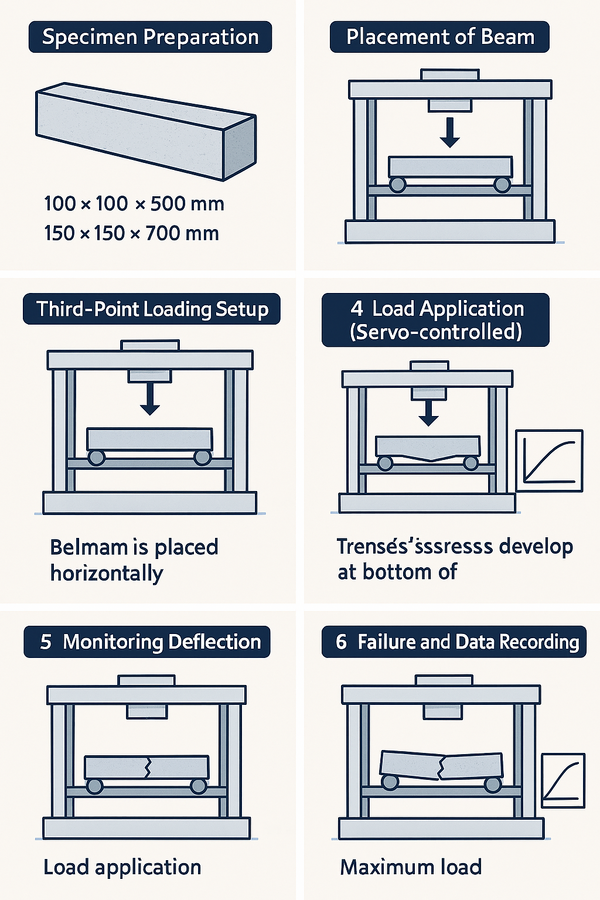
The test involves placing a simply supported concrete beam inside the testing frame and applying load at third points (third-point loading method). This loading configuration ensures a constant bending moment in the central region of the beam.The machine continuously records the load versus deflection curve, which is essential for evaluating the flexural behavior of both plain and fiber reinforced concrete.
Step-by-Step Working Procedure of Flexure Testing Machine
Step 1: Specimen Preparation
Concrete beam specimens are cast according to standard dimensions:- 100 × 100 × 500 mm
- 150 × 150 × 700 mm
Step 2: Placement of Beam
The beam is placed horizontally on two lower support rollers inside the machine. Proper alignment is ensured so that the beam is centered and stable.Step 3: Third-Point Loading Setup
Two loading points are positioned at one-third distances from each support. This ensures uniform bending stress distribution in the central zone of the beam.Step 4: Load Application (Servo-Controlled)
The hydraulic actuator applies load gradually through the servo control system. Since the system operates in a closed-loop configuration, it maintains precise loading rates as per ASTM or IS standards.Step 5: Monitoring Deflection
As the load increases:- The beam begins to bend.
- Tensile stresses develop at the bottom.
- Cracks initiate at the mid-span.
Step 6: Failure and Data Recording
The test continues until:- Maximum load is reached.
- The beam fails.
Importance of Load-Deflection Curve in FRC Testing using Flexure Testing Machine
One of the major advantages of the servo-controlled system is accurate measurement of the load-deflection curve. This curve helps determine:- First crack strength
- Peak flexural strength
- Residual strength
- Toughness index
- Energy absorption capacity
Industry-Wise Applications
1. Construction Industry
The machine is widely used for testing structural beams used in residential, commercial, and industrial buildings. It ensures beams meet required flexural strength standards.2. Highway and Pavement Industry
Concrete pavements are subjected to heavy bending stresses due to traffic loads. Flexural strength testing ensures durability and crack resistance of pavement slabs.3. Research and Development Laboratories
Universities and R&D institutions use the servo flexure testing machine for:- Studying new fiber technologies
- Evaluating high-performance concrete
- Investigating crack behavior and toughness
4. Precast Concrete Manufacturing
Precast beam manufacturers use flexural testing to verify product quality before dispatch.5. Fiber Reinforced Concrete Producers
Manufacturers of steel, synthetic, or hybrid fiber reinforced concrete rely on testing to validate fiber performance and post-crack strength.Advantages of Servo-Controlled Flexure Testing Machine
- High accuracy and repeatability
- Controlled loading rate
- Precise load-deflection recording
- Ideal for FRC performance evaluation
- Complies with international testing standards

