
You are using an out of date browser. It may not display this or other websites correctly.
You should upgrade or use an alternative browser.
You should upgrade or use an alternative browser.
detection of leakage
- Thread starter hary1973
- Start date


In a residential apartment, if there is leakage, how can we detect the source of leakage? What should we look at?
This is a very complex question and hence there will a complex reply.....

Lets start with the most common leakages point by point and here we are going to talk only on how to detect the leakages.......
- PLINTH LEVEL, if there is subsoil water then due to capillary action damp patches will be seen on the walls or flooring etc. this could be because we have not left any pressure release pipes or not provided damp proof course etc. It also could be due to leakages in pipes like domestic risers lines or drainage lines which have ruptured or joints have given way etc and water is oozing out from the cracks in the respective PCC etc.
- EXTERNAL WALLS, if you see leakages on the inside then such leakages could be due to cracks in the external plaster, separating joint between masonry and RCC elements, if its mivan ( alluminium shuttering ) walls then it could be at the starter block, wall ties, or honeycombs etc or construction joints.
- INTERNAL WALLS, if you see leakages internally then it could be due to bath/toilet walls attached to living/kit/bed etc and mostly its due to leaking plumbing joints or drainage joints, this can be identified by using colored water either by dosing color in storage tank to find out plumbing leakage or using colored water in-floor traps to detect the drainage leakages.
- TERRACE LEVEL, by ponding water on the terrace you can detect the source of leakages from the terrace.
- BATHROOM/TOILETS, by ponding water in the bathroom/toilets for minimum of 24 hours you can detect leakages from bathrooms/toilets
- EXTERNAL WALLS, using a dripper from terrace parapet wall and drip water on the walls for at least 1 hour to create a rainfall situation and check the leakages from external walls.
- OHWT you can once again use colored water to trace the source of leakages at the color will be visible from bottom or sidewalls.
- Sometimes it becomes difficult to find the source but if you see the seepages internally then you can make use of MOISTURE METERS here depending on the percentage of moisture in the meter you can ascertain more the moisture more near you are to the source of leakage.
- When the interior of the building develops low pressure when compared with that of the external pressure, due to suction effect, during high humid conditions, the air carrying external moisture may intrude inside the structure causing damp conditions.
- During erection of scaffolding particularly for external plaster, holes are made for supporting one end of horizontal member of scaffold in walls. These holes are filled up negligently while removing scaffolding. Such holes are never filled with care. And again it is difficult to cure such isolated patches. Hence all such holes become a source of water into walls and appear as damp patches later on in walls.
- Similarly while installing Air conditioner particularly split units, holes are made in walls for gas/exhaust pipes. Such holes too are never filled with care and hence can be a source of leakages internally.
- Poor quality bricks (having water absorption > 20%) and or with poor cement mortar joints.
- Sometimes moisture trapped between the matrix of concrete and the surface finishing such as exterior emulsion paints does not allow the moisture to escape or migrate to other places, thereby causing dampness. Hope that am able to put down some of my experiences if others have additional information then request to put down your experiences so that all at CIVIL4M will benefit.

Sir Is it possible that Rain water flow contineously from Slab cracks (which was entered from External plaster i.e. joint of Masonary and RCC Slab)EXTERNAL WALLS, if you see leakages on the inside then such leakages could be due to cracks in the external plaster, separating joint between masonry and RCC elements, if its mivan ( alluminium shuttering ) walls then it could be at the starter block, wall ties, or honeycombs etc or construction joints.
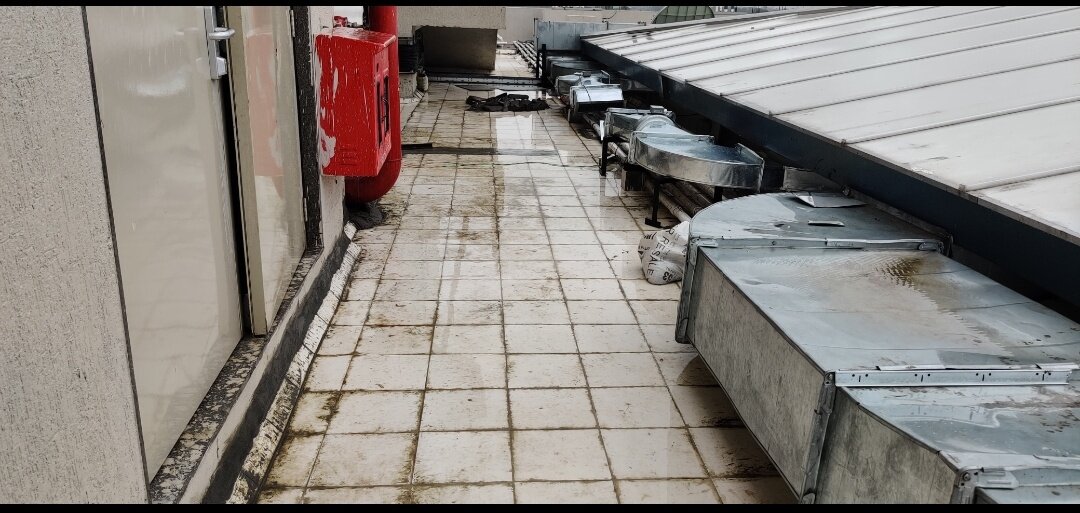
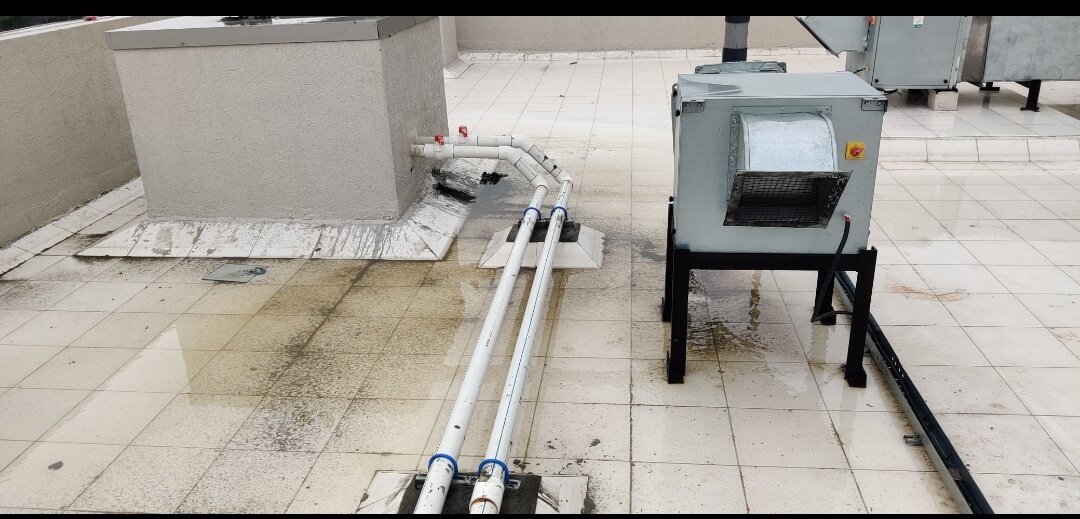
Sir, Is it possible that Rain water broke the barrier of Tiles > Protective screed > APP Membrane > Mother Slab (Shrinkage Crack). We have found some leakages in slab from location shown in Picture.TERRACE LEVEL, by ponding water on the terrace you can detect the source of leakages from the terrace.
Attachments

Dnyan Deshmukh
Staff member
Yes it is possible for water to do that when it found weakest link.Sir, Is it possible that Rain water broke the barrier of Tiles > Protective screed > APP Membrane > Mother Slab (Shrinkage Crack). We have found some leakages in slab from location shown in Picture.
To repair, if you have tiled all terrace, ensure you use only epoxy grout exterior grade type to fill those joint.
Joint filling is only possible when there is at least 1mm gap in tiles, ideal size is 2 to 3mm.
Paper joint or jointless tiling will cause the water to seep down when there is a stagnant water.
Dnyan Deshmukh
Staff member
If you are not able to find the source, you can make use of technology such as Thermal scanner / imaging to trace the route of water to its source.In a residential apartment, if there is leakage, how can we detect the source of leakage? What should we look at?
shivanand Mali
Apprentice
Hi,In a residential apartment, if there is leakage, how can we detect the source of leakage? What should we look at?
As I am seeing in picture water stagnate on the floor, you have to give proper slope in tile, so water can flow properly toward outlet pipe so 50% problem will resolve, balance 50% fill all the tile joint properly with external epoxy grout, I fill you will do this problem can minimize.

The same problem I am also facing even I ve changed the over head tank ..but still there is unusual drawn w/o any wet mark.In a residential apartment, if there is leakage, how can we detect the source of leakage? What should we look at?
olivermoss
Newbie
Leakage detection usually comes down to narrowing where moisture is entering and when it appears. The first reply already covers structural and plumbing checks very well, so I’ll add a more practical, step-by-step angle that often helps in residential apartments.
Start by observing patterns. If dampness increases only after rainfall, the source is typically external, terrace slab, parapet walls, façade cracks, or failed waterproofing layers (as mentioned in the second reply). If leakage appears even in dry weather, plumbing lines, concealed joints, or drainage pipes are more likely.
Next, isolate systems one at a time. Temporarily stop using a specific bathroom, kitchen line, or overhead tank and monitor whether the seepage reduces. This simple elimination method often saves unnecessary breaking of finishes. For slab-related doubts, controlled ponding (24–48 hours) combined with marking seepage points below gives clearer confirmation than visual inspection alone.
In many apartments, leaks are also traced back to AC-related penetrations, poorly sealed core holes, condensate drain backflow, or insulation failure. This is common in humid climates where cooling systems run year-round. In Singapore-based buildings, specialists such as SoCool often encounter cases where water stains blamed on slab cracks were actually caused by concealed air-conditioning drainage issues or condensation migrating through wall cavities. Using moisture mapping tools and thermal checks helps pinpoint these hidden sources before repairs begin. You can learn more about professional diagnostic approaches.
Lastly, always check previous renovation points, tile replacements, membrane cutouts, or patched plumbing joints, since leakages frequently originate where original waterproofing continuity was disturbed.
A methodical approach, observe, isolate, test, then confirm, reduces guesswork and prevents repeated repairs that don’t address the real source.
Start by observing patterns. If dampness increases only after rainfall, the source is typically external, terrace slab, parapet walls, façade cracks, or failed waterproofing layers (as mentioned in the second reply). If leakage appears even in dry weather, plumbing lines, concealed joints, or drainage pipes are more likely.
Next, isolate systems one at a time. Temporarily stop using a specific bathroom, kitchen line, or overhead tank and monitor whether the seepage reduces. This simple elimination method often saves unnecessary breaking of finishes. For slab-related doubts, controlled ponding (24–48 hours) combined with marking seepage points below gives clearer confirmation than visual inspection alone.
In many apartments, leaks are also traced back to AC-related penetrations, poorly sealed core holes, condensate drain backflow, or insulation failure. This is common in humid climates where cooling systems run year-round. In Singapore-based buildings, specialists such as SoCool often encounter cases where water stains blamed on slab cracks were actually caused by concealed air-conditioning drainage issues or condensation migrating through wall cavities. Using moisture mapping tools and thermal checks helps pinpoint these hidden sources before repairs begin. You can learn more about professional diagnostic approaches.
Lastly, always check previous renovation points, tile replacements, membrane cutouts, or patched plumbing joints, since leakages frequently originate where original waterproofing continuity was disturbed.
A methodical approach, observe, isolate, test, then confirm, reduces guesswork and prevents repeated repairs that don’t address the real source.

ferrer.vicente1997@gmail.
Newbie
amd007's diagnostic framework is the right starting point — identifying the source before touching anything is non-negotiable. I'd add the layer that often gets skipped: once you've found the source, the repair system has to match the failure mechanism, not just the visible symptom.
The most common mistake I see in residential buildings in India: applying a cementitious waterproofing coat over an active leak without addressing what's driving the moisture. Result is the coating debonds within one monsoon cycle.
Rough guide by source type:
— Rising damp (capillary from ground): needs a physical or chemical DPC at plinth level. Surface coatings alone won't stop capillary pressure. Crystalline injection systems work well on established walls.
— Penetrating damp (rain-driven through cracks or joints): repoint with sulphate-resistant mortar, fill cracks with flexible sealant before any coating. The wall needs to be genuinely dry — not just surface-dry — before application.
— Slab/terrace: if APP membrane is intact but water enters through tile joints (as in the photos above), epoxy grout CG2 class with good chemical resistance is the right fix. Standard cementitious grout stays porous even when freshly applied.
— Plumbing-related: no construction chemical fixes a leaking joint. Pipe first, then address residual moisture damage.
The 24-48hr ponding test Dnyan mentions is the most reliable confirmation method for slab sources before committing to a repair system.
I write about waterproofing and material selection for Indian conditions at builtbychemistry.com?utm_source=forum&utm_medium=comment&utm_campaign=civil4m — working out of Rajasthan, this kind of layered failure comes up constantly.
The most common mistake I see in residential buildings in India: applying a cementitious waterproofing coat over an active leak without addressing what's driving the moisture. Result is the coating debonds within one monsoon cycle.
Rough guide by source type:
— Rising damp (capillary from ground): needs a physical or chemical DPC at plinth level. Surface coatings alone won't stop capillary pressure. Crystalline injection systems work well on established walls.
— Penetrating damp (rain-driven through cracks or joints): repoint with sulphate-resistant mortar, fill cracks with flexible sealant before any coating. The wall needs to be genuinely dry — not just surface-dry — before application.
— Slab/terrace: if APP membrane is intact but water enters through tile joints (as in the photos above), epoxy grout CG2 class with good chemical resistance is the right fix. Standard cementitious grout stays porous even when freshly applied.
— Plumbing-related: no construction chemical fixes a leaking joint. Pipe first, then address residual moisture damage.
The 24-48hr ponding test Dnyan mentions is the most reliable confirmation method for slab sources before committing to a repair system.
I write about waterproofing and material selection for Indian conditions at builtbychemistry.com?utm_source=forum&utm_medium=comment&utm_campaign=civil4m — working out of Rajasthan, this kind of layered failure comes up constantly.
Similar threads

- Replies
- 1
- Views
- 747

- Replies
- 0
- Views
- 565
