

Every structure in civil engineering depends on one critical factor: the quality of the ground and construction materials beneath it. From residential buildings and highways to bridges, dams, and skyscrapers, long-term structural performance starts with understanding geomaterials such as soil, sand, gravel, and aggregates.
Before any construction project begins, engineers need to answer an important question: Are the materials suitable for the intended use? One of the most reliable ways to determine this is through sieve analysis.
Sieve analysis is one of the most widely used laboratory tests in geotechnical and construction engineering because it reveals the particle size distribution of materials. This information helps engineers make informed decisions about strength, stability, drainage, and overall performance of construction materials.

Sieve analysis, also called a gradation test, is a laboratory method used to determine the distribution of particle sizes within granular materials such as soil, sand, crushed stone, and aggregates.
The process involves passing a known quantity of material through a stack of sieves with progressively smaller openings. The material retained on each sieve is weighed and analyzed to determine the percentage of particles within specific size ranges.
The resulting data provides valuable insight into the texture and characteristics of a material, helping engineers predict how it will behave under load, moisture changes, and environmental conditions.
Sieve analysis plays a crucial role in several areas of civil engineering. The information obtained from this test directly affects design decisions, material selection, and construction quality.
By determining the proportion of gravel, sand, and fine particles, engineers can estimate:
When aggregate particles are nearly identical in size, large spaces or voids develop between them. These gaps require additional cement paste to fill, increasing cost and potentially reducing efficiency.
A well-graded aggregate mix contains large, medium, and small particles that fit together more effectively. This creates:
Proper aggregate gradation contributes to:
Fine particles can block void spaces and reduce drainage efficiency.
Using sieve analysis data, engineers can estimate hydraulic properties and evaluate drainage performance using empirical methods such as Hazen's equation.
Well-graded soils compact more effectively because smaller particles fill spaces between larger particles. Better particle interlocking leads to:
From this graph, engineers determine three important particle diameters:
Uniformity Coefficient (Cu)
Calculates the spread of particle sizes to determine if the material is well-graded or poorly-graded.
Cu = D60/D10
(A higher value indicates a wider range of particle sizes).
Coefficient of Curvature (Cc)
Defines the shape of the gradation curve.
Cc = (D30*D30)/D10*D60
(For a soil to be considered well-graded,Cc typically falls between 1 and 3).
Although modern engineering increasingly relies on digital technologies and advanced modelling tools, sieve analysis continues to be one of the most essential laboratory tests in civil engineering.
Its importance goes far beyond simply measuring particle sizes. Sieve analysis provides the foundation for soil classification, concrete and asphalt mix design, drainage assessment, and compaction analysis. The data obtained from this test allows engineers to build safer structures, improve material efficiency, and increase infrastructure lifespan.
In simple terms, before engineers build on the ground, they first need to understand it—and sieve analysis remains one of the most reliable tools for doing exactly that.
Before any construction project begins, engineers need to answer an important question: Are the materials suitable for the intended use? One of the most reliable ways to determine this is through sieve analysis.
Sieve analysis is one of the most widely used laboratory tests in geotechnical and construction engineering because it reveals the particle size distribution of materials. This information helps engineers make informed decisions about strength, stability, drainage, and overall performance of construction materials.
What is Sieve Analysis of soil or aggregate ?
Sieve analysis, also called a gradation test, is a laboratory method used to determine the distribution of particle sizes within granular materials such as soil, sand, crushed stone, and aggregates.
The process involves passing a known quantity of material through a stack of sieves with progressively smaller openings. The material retained on each sieve is weighed and analyzed to determine the percentage of particles within specific size ranges.
The resulting data provides valuable insight into the texture and characteristics of a material, helping engineers predict how it will behave under load, moisture changes, and environmental conditions.
Why Sieve Analysis Is Important in Civil Engineering testing ?
Sieve analysis plays a crucial role in several areas of civil engineering. The information obtained from this test directly affects design decisions, material selection, and construction quality.
1. Soil Classification and Prediction of Engineering Behaviours
Soils are generally classified into two major categories:- Coarse-grained soils: sand and gravel
- Fine-grained soils: silt and clay
By determining the proportion of gravel, sand, and fine particles, engineers can estimate:
- Settlement behaviour
- Load-bearing capacity
- Soil stability
- Swelling and shrinkage characteristics
- Compaction performance
2. Concrete and Asphalt Mix Design
Aggregates account for a significant portion of construction materials:- Around 60–75% of concrete volume
- More than 90% of asphalt mixtures
When aggregate particles are nearly identical in size, large spaces or voids develop between them. These gaps require additional cement paste to fill, increasing cost and potentially reducing efficiency.
A well-graded aggregate mix contains large, medium, and small particles that fit together more effectively. This creates:
- Higher density
- Improved strength
- Reduced cement demand
- Better durability
Proper aggregate gradation contributes to:
- Better load distribution
- Reduced rutting
- Improved resistance to cracking
- Increased pavement life
3. Permeability and Drainage Evaluation
Water movement through soil is a major consideration in civil engineering projects, particularly for:- Retaining walls
- Embankments
- Highway subgrades
- Earthen dams
- Drainage systems
Fine particles can block void spaces and reduce drainage efficiency.
Using sieve analysis data, engineers can estimate hydraulic properties and evaluate drainage performance using empirical methods such as Hazen's equation.
4. Compaction and Shear Strength Improvement
Compaction is performed to reduce air voids and increase the density of soil before construction begins.Well-graded soils compact more effectively because smaller particles fill spaces between larger particles. Better particle interlocking leads to:
- Higher shear strength
- Increased load-bearing capacity
- Reduced settlement
- Greater foundation stability
How Is Sieve Analysis Performed? Step wise procedure of Sieve Analysis of soil or aggregate sample
The sieve analysis process is relatively straightforward but requires accuracy and standardized procedures.Step 1: Sample Preparation for sieve analysis
A representative soil or aggregate sample is collected and dried thoroughly to remove moisture.Step 2: Arranging the Sieve Stack for sieve analysis
The sieves are placed vertically in descending order:- Largest openings at the top
- Smallest openings at the bottom
- A pan underneath to collect fine particles
Step 3: Mechanical Shaking the sieve set
The sample is placed into the top sieve and shaken using a mechanical sieve shaker for approximately 10–15 minutes.Step 4: Measuring Retained Material in the sieve
After shaking, the material retained on each sieve is weighed separately.Step 5: Data Calculation
Engineers determine:- Percentage retained on each sieve
- Cumulative percentage retained
- Percentage passing each sieve
Understanding Particle Size Distribution Curves
The results from sieve analysis are plotted on a semi-logarithmic graph called a Particle Size Distribution (PSD) curve.From this graph, engineers determine three important particle diameters:
- D10 → particle size at which 10% of material is finer
- D30 → particle size at which 30% of material is finer
- D60 → particle size at which 60% of material is finer
Uniformity Coefficient (Cu)
Calculates the spread of particle sizes to determine if the material is well-graded or poorly-graded.
Cu = D60/D10
(A higher value indicates a wider range of particle sizes).
Coefficient of Curvature (Cc)
Defines the shape of the gradation curve.
Cc = (D30*D30)/D10*D60
(For a soil to be considered well-graded,Cc typically falls between 1 and 3).
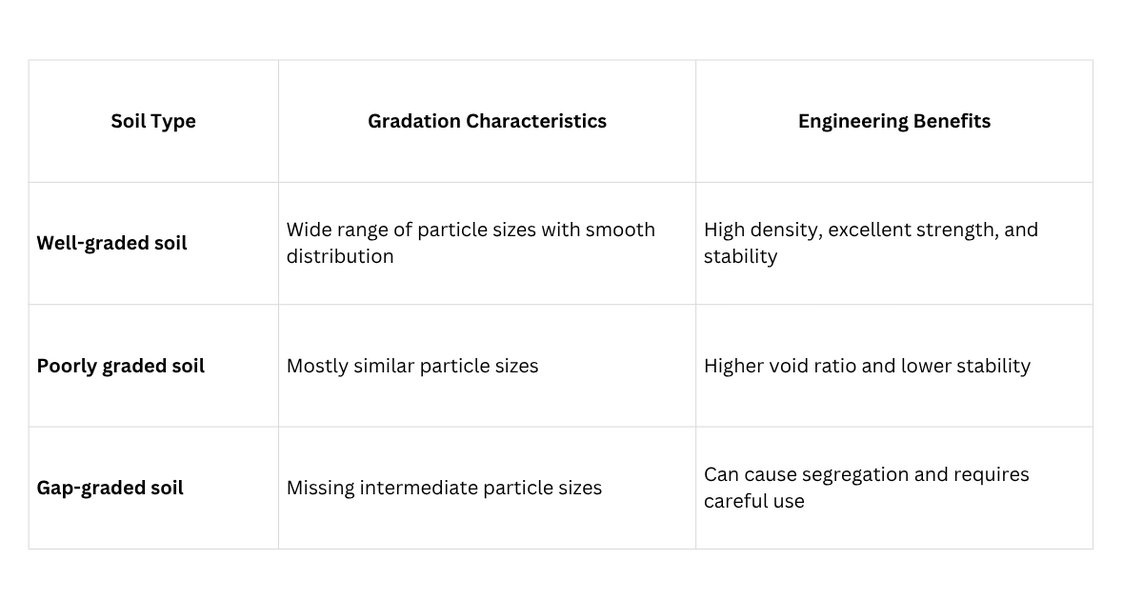
Types of Soil Gradation and Their Engineering Significance
Benefits of Sieve Analysis in Construction Projects
Sieve analysis offers several practical advantages:- Improves construction quality
- Reduces material wastage
- Supports cost optimization
- Enhances structural safety
- Helps meet engineering standards
- Improves durability and long-term performance
Although modern engineering increasingly relies on digital technologies and advanced modelling tools, sieve analysis continues to be one of the most essential laboratory tests in civil engineering.
Its importance goes far beyond simply measuring particle sizes. Sieve analysis provides the foundation for soil classification, concrete and asphalt mix design, drainage assessment, and compaction analysis. The data obtained from this test allows engineers to build safer structures, improve material efficiency, and increase infrastructure lifespan.
In simple terms, before engineers build on the ground, they first need to understand it—and sieve analysis remains one of the most reliable tools for doing exactly that.
Last edited:
