

Concretes long-term performance depends heavily on how easily water and aggressive chemicals can enter its internal pore structure. In reinforced concrete structures, chloride ion penetration is a major durability concern because chlorides can reach the reinforcement and initiate corrosion.
The Rapid Chloride Permeability Test (RCPT) is one of the commonly used laboratory methods for evaluating the resistance of concrete to chloride-ion penetration. The test provides a rapid electrical indication of how readily ions can pass through a concrete specimen.
The Rapid Chloride Permeability Test (RCPT) is one of the commonly used laboratory methods for evaluating the resistance of concrete to chloride-ion penetration. The test provides a rapid electrical indication of how readily ions can pass through a concrete specimen.
What Is the Rapid Chloride Permeability (RCPT) Test?
The Rapid Chloride Permeability Test (RCPT) is a laboratory test used to obtain a rapid indication of the resistance of concrete to chloride-ion penetration.
The method is standardized under ASTM C1202, titled Standard Test Method for Electrical Indication of Concrete's Ability to Resist Chloride Ion Penetration. Rather than directly measuring the amount of chloride entering concrete, the test measures the electrical charge passed through a saturated concrete specimen during a specified period.
The total charge is reported in coulombs (C). In general, a lower charge indicates lower electrical conductance and is associated with greater resistance to ionic transport.
The test is widely used for:
The method is standardized under ASTM C1202, titled Standard Test Method for Electrical Indication of Concrete's Ability to Resist Chloride Ion Penetration. Rather than directly measuring the amount of chloride entering concrete, the test measures the electrical charge passed through a saturated concrete specimen during a specified period.
The total charge is reported in coulombs (C). In general, a lower charge indicates lower electrical conductance and is associated with greater resistance to ionic transport.
The test is widely used for:
- Concrete mix design and comparison
- Durability assessment
- Quality control
- Research and development
- Evaluation of supplementary cementitious materials
- Concrete intended for chloride-exposed environments
Why Is Rapid Chloride Permeability Test RCPT Important ?
The durability of reinforced concrete is strongly influenced by the movement of aggressive substances through its pore network.
Chlorides and Reinforcement Corrosion
When chloride ions enter reinforced concrete and reach the steel reinforcement at a sufficient concentration, they can disrupt the protective passive film surrounding the reinforcement.
This can initiate reinforcement corrosion.
The corrosion process can subsequently cause:
Chloride penetration → Reinforcement corrosion → Rust formation → Expansion → Concrete cracking → Spalling → Loss of durability
This is particularly important in structures exposed to:
This can initiate reinforcement corrosion.
The corrosion process can subsequently cause:
Chloride penetration → Reinforcement corrosion → Rust formation → Expansion → Concrete cracking → Spalling → Loss of durability
This is particularly important in structures exposed to:
- Seawater and marine environments
- Coastal atmospheres
- Chloride-contaminated groundwater
- De-icing salts
- Industrial environments containing chloride compounds
- Bridges, parking structures and other chloride-exposed infrastructure
Therefore, understanding the resistance of concrete to ionic transport is an important part of durability-oriented concrete design.
What Does Rapid Chloride Permeability Test RCPT Actually Measure?
One important point is often overlooked: RCPT does not directly measure chloride diffusion or chloride concentration at different depths.
Instead, it measures the electrical conductance of concrete by determining the total electrical charge passing through a specimen during the test.
ASTM describes the method as providing a rapid indication of the concrete's resistance to chloride-ion penetration.
The basic principle is:
Instead, it measures the electrical conductance of concrete by determining the total electrical charge passing through a specimen during the test.
ASTM describes the method as providing a rapid indication of the concrete's resistance to chloride-ion penetration.
The basic principle is:
- Higher charge passed → higher electrical conductance → generally greater ionic transport
- Lower charge passed → lower electrical conductance → generally greater resistance to ionic transport
Because electrical current can be carried by different ions in the concrete pore solution, RCPT results should be interpreted as an electrical indication of ionic penetrability, rather than as a direct measurement of chloride diffusion.
Rapid Chloride Permeability Test (RCPT) Apparatus and Test Setup
The basic RCPT apparatus consists of an electrical supply, test cell, concrete specimen, electrodes, solution chambers and a current-measuring system.
A typical specimen is approximately:
A typical specimen is approximately:
- Diameter: 100 mm
- Thickness: 50 mm
ASTM C1202 specifies the method for nominal 100 mm specimens, with appropriate provisions for other specimen diameters.
The specimen is sealed between two chambers.
The specimen is sealed between two chambers.
Chemical Solutions for Rapid Chloride Permeability Test
The conventional Rapid Chloride Permeability Test (RCPT) setup uses Chloride-side solution:
- 3% sodium chloride (NaCl) solution
- Alkaline-side solution:
- 0.3 N sodium hydroxide (NaOH) solution
A constant electrical potential of 60 V DC is applied across the specimen.
The test is normally conducted for 6 hours. The current passing through the specimen is monitored during the test.
The test is normally conducted for 6 hours. The current passing through the specimen is monitored during the test.
Working Principle of the Rapid Chloride Permeability Test (RCPT)
The Rapid Chloride Permeability Test (RCPT) works on the principle of electrically accelerated ionic transport through a concrete specimen. In this test, a conditioned concrete disc is placed between two chambers containing 3% sodium chloride (NaCl) solution and 0.3 N sodium hydroxide (NaOH) solution, respectively. A constant electrical potential of 60 V DC is applied across the specimen for 6 hours, creating an electric field that drives ions through the concrete's pore structure.
During the test, the electrical current passing through the concrete is continuously monitored or recorded at specified time intervals. The recorded current is then used to calculate the total electrical charge passed through the specimen, expressed in coulombs. In general, a lower charge passed indicates lower electrical conductivity and greater resistance to ionic transport, while a higher charge indicates greater ionic transport. Therefore, the RCPT result provides a rapid electrical indication of the concrete's resistance to chloride-ion penetration, making it useful for comparing concrete mixtures and evaluating durability. However, RCPT does not directly measure chloride diffusion; the measured electrical current can be influenced by other ions present in the concrete pore solution and by factors such as moisture condition, curing, age, and concrete composition.
Step-by-Step Test procedure of Rapid Chloride Permeability Test (RCPT)
Step 1: Prepare the Concrete Specimen for Rapid Chloride Permeability Test (RCPT)
A cylindrical concrete specimen is prepared and cut to approximately 100 mm diameter × 50 mm thickness.
The specimen should represent the concrete mixture being investigated.
Proper specimen preparation is critical because surface condition, moisture condition, age and curing can significantly influence the result.
The specimen should represent the concrete mixture being investigated.
Proper specimen preparation is critical because surface condition, moisture condition, age and curing can significantly influence the result.
Step 2: Condition and Saturate the concrete specimen for Rapid Chloride Permeability Test (RCPT)
The concrete specimen is conditioned according to the applicable test procedure so that its internal pore system reaches the required moisture condition.
Saturation is particularly important because the electrical current passes primarily through the liquid-filled pore network.
The curing age and curing procedure should be clearly controlled because ASTM notes that both specimen age and curing can have significant effects on RCPT results.
Saturation is particularly important because the electrical current passes primarily through the liquid-filled pore network.
The curing age and curing procedure should be clearly controlled because ASTM notes that both specimen age and curing can have significant effects on RCPT results.
Step 3: Mount the Specimen in Rapid Chloride Permeability Test (RCPT)
The concrete disc is placed between the two chambers of the Rapid Chloride Permeability Test (RCPT) cell.
The edges are sealed carefully to prevent leakage and to ensure that the electrolyte solutions contact the intended specimen surfaces.
Poor sealing can result in leakage or unintended current paths and may compromise the test.
The edges are sealed carefully to prevent leakage and to ensure that the electrolyte solutions contact the intended specimen surfaces.
Poor sealing can result in leakage or unintended current paths and may compromise the test.
Step 4: Fill the Chambers With Sodium chloride and Sodium hydroxide Solutions
The two chambers are filled with the required solutions:
- 3% NaCl solution on the chloride side
- 0.3 N NaOH solution on the opposite side
The solutions provide the conductive environment required for the electrical test.
Step 5: Apply 60 V DC across the specimen
The electrical connections are made and a constant 60 V DC potential is applied across the concrete specimen.
This electrical field drives ionic movement through the pore system.
This electrical field drives ionic movement through the pore system.
Step 6: Record the Current passing through the concrete specimen
The current passing through the specimen is measured at regular intervals during the test.
The current normally changes with time, so recording several readings provides the data needed to determine the total charge passed.
The current normally changes with time, so recording several readings provides the data needed to determine the total charge passed.
Step 7: Calculate the Total Charge Passed through the concrete sample
The current-time data are integrated to obtain the total electrical charge passed through the specimen.
In simplified form:
Q = ∫ I dt
Where:
• Q = total charge passed, in coulombs
• I = current, in amperes
• t = time, in seconds
For discrete measurements, numerical methods such as the trapezoidal rule can be used to calculate the area under the current-versus-time curve.
The final result is expressed in coulombs.
In simplified form:
Q = ∫ I dt
Where:
• Q = total charge passed, in coulombs
• I = current, in amperes
• t = time, in seconds
For discrete measurements, numerical methods such as the trapezoidal rule can be used to calculate the area under the current-versus-time curve.
The final result is expressed in coulombs.
Discussing the Rapid Chloride Permeability Test (RCPT) Results and Chloride Ion Penetrability
One of the most commonly referenced ASTM C1202 classifications is based on the total charge passed.
- If Total Charge Passed is greater than 4,000 C , the Chloride Ion Penetrability is High
- If Total Charge Passed is Between 2,000 to 4,000 C , the Chloride Ion Penetrability is Moderate
- If Total Charge Passed is Between 1,000 to 2,000 C , the Chloride Ion Penetrability is Low
- If Total Charge Passed is Between 100 to 1,000 C , the Chloride Ion Penetrability is Very Low
- If Total Charge Passed is below 100 C , the Chloride Ion Penetrability is Negligible
These categories are a qualitative classification of chloride-ion penetrability based on charge passed, rather than a direct measurement of chloride diffusion.
Example - Suppose two concrete mixes are tested :
Mix A: 4,500 C
Mix B: 900 C
Based on the conventional ASTM classification, Mix A falls in the high penetrability range, while Mix B falls in the very low range.
This does not mean that Mix B will never allow chloride penetration. Rather, under the conditions of the test, it exhibited substantially lower electrical charge passage.
Example - Suppose two concrete mixes are tested :
Mix A: 4,500 C
Mix B: 900 C
Based on the conventional ASTM classification, Mix A falls in the high penetrability range, while Mix B falls in the very low range.
This does not mean that Mix B will never allow chloride penetration. Rather, under the conditions of the test, it exhibited substantially lower electrical charge passage.
Why Lower Rapid Chloride Permeability Test (RCPT) Values Are Generally Preferred
A lower Rapid Chloride Permeability Test (RCPT) value generally indicates that less electrical charge passed through the specimen during the test.
For many conventional concrete mixtures, this corresponds to a denser or less electrically conductive pore system and greater resistance to ionic transport.
This is why engineers often use RCPT values to compare concrete mixtures.
For example, replacing part of the Portland cement with appropriate supplementary cementitious materials (SCMs) may refine the pore structure and reduce electrical charge passed.
However, the interpretation should always consider the concrete's composition and curing history.
For many conventional concrete mixtures, this corresponds to a denser or less electrically conductive pore system and greater resistance to ionic transport.
This is why engineers often use RCPT values to compare concrete mixtures.
For example, replacing part of the Portland cement with appropriate supplementary cementitious materials (SCMs) may refine the pore structure and reduce electrical charge passed.
However, the interpretation should always consider the concrete's composition and curing history.
Factors Affecting Rapid Chloride Permeability Test (RCPT) Results
Rapid Chloride Permeability Test (RCPT) results can vary considerably depending on the concrete and testing conditions.
Important factors include :
Concrete Age
Important factors include :
Concrete Age
- Concrete generally becomes less permeable as hydration and microstructural development continue.
- ASTM specifically notes that sample age can significantly affect test results.
Curing Conditions
- Moisture and curing duration have a strong influence on concrete pore structure.
- Therefore, specimens being compared should have consistent curing histories.
Cement Type
- Different cement compositions can produce different pore structures and pore-solution chemistries.
Supplementary Cementitious Materials
- Materials such as fly ash, slag and silica fume can significantly influence electrical conductivity and chloride transport characteristics.
Admixtures
- Chemical admixtures can alter the ionic composition of the pore solution and therefore influence electrical current.
Moisture Condition
- Because electrical current depends strongly on the conductive pore network, specimen conditioning is critical.
Temperature
- The electrical current and pore-solution conductivity can be affected by temperature. The electrical loading can also increase specimen temperature during testing.
Limitations of the Rapid Chloride Permeability Test (RCPT) Test
Although Rapid Chloride Permeability Test (RCPT) is quick and useful, it should not be treated as a perfect direct measurement of chloride permeability.
The major limitation is that the electrical current is influenced by all ions capable of carrying electrical charge in the pore solution—not only chloride ions.
Research and technical guidance have identified additional concerns, including specimen heating and the fact that the test measures electrical conductance under an imposed electrical field rather than chloride transport under natural exposure.
Therefore, caution is particularly important when comparing concretes with substantially different pore-solution chemistry or unusual admixture systems.
ASTM also recommends care when interpreting results from some surface-treated concretes because Rapid Chloride Permeability Test (RCPT) results may not always correspond directly with longer-duration chloride ponding behavior.
The major limitation is that the electrical current is influenced by all ions capable of carrying electrical charge in the pore solution—not only chloride ions.
Research and technical guidance have identified additional concerns, including specimen heating and the fact that the test measures electrical conductance under an imposed electrical field rather than chloride transport under natural exposure.
Therefore, caution is particularly important when comparing concretes with substantially different pore-solution chemistry or unusual admixture systems.
ASTM also recommends care when interpreting results from some surface-treated concretes because Rapid Chloride Permeability Test (RCPT) results may not always correspond directly with longer-duration chloride ponding behavior.
Rapid Chloride Permeability Test (RCPT) vs. Actual Chloride Exposure
It is important to understand the difference between an accelerated electrical test and natural chloride exposure.
In an actual structure, chloride ions may enter concrete through mechanisms such as:
In an actual structure, chloride ions may enter concrete through mechanisms such as:
- Diffusion
- Capillary absorption
- Permeation
- Cracks and defects
- Moisture movement
Rapid Chloride Permeability Test (RCPT) accelerates ionic transport by applying a strong electrical potential.
Consequently, Rapid Chloride Permeability Test (RCPT) should primarily be viewed as a rapid comparative or quality-control indicator, particularly when the concrete type and test conditions are appropriate and well controlled.
ASTM notes that correlations have been established between Rapid Chloride Permeability Test (RCPT) results and long-term chloride ponding tests for applicable concrete types.
Consequently, Rapid Chloride Permeability Test (RCPT) should primarily be viewed as a rapid comparative or quality-control indicator, particularly when the concrete type and test conditions are appropriate and well controlled.
ASTM notes that correlations have been established between Rapid Chloride Permeability Test (RCPT) results and long-term chloride ponding tests for applicable concrete types.
Applications of RCPT in Civil Engineering
Rapid Chloride Permeability Test (RCPT) can be useful throughout the concrete development and construction process.
- Mix Design - Engineers can compare different concrete mixtures and investigate how changes in cementitious materials, water-to-binder ratio and SCM content affect ionic transport.
- Durability Design - RCPT can provide supporting information when selecting concrete for chloride-exposed structures.
- Quality Control - The test can be incorporated into laboratory quality-control programs where appropriate acceptance criteria have been established.
- Research and Development - Researchers can use RCPT to compare new cementitious materials, admixtures and concrete technologies.
- High-Performance Concrete - RCPT has been widely used in the evaluation of high-performance concrete and other low-permeability concrete systems.
How Rapid Chloride Permeability Test (RCPT) Helps Improve RCC Durability ?
For reinforced concrete, durability is not simply about achieving high compressive strength.
A concrete can have adequate strength but still require careful consideration of its transport properties when exposed to aggressive environments.
Rapid Chloride Permeability Test (RCPT) provides an additional durability-related parameter by indicating the electrical charge passed through the concrete.
A simplified durability concept is:
Dense concrete → Lower ionic transport → Reduced opportunity for chloride ingress → Better protection of reinforcement
However, RCPT should be considered together with other factors such as:
A concrete can have adequate strength but still require careful consideration of its transport properties when exposed to aggressive environments.
Rapid Chloride Permeability Test (RCPT) provides an additional durability-related parameter by indicating the electrical charge passed through the concrete.
A simplified durability concept is:
Dense concrete → Lower ionic transport → Reduced opportunity for chloride ingress → Better protection of reinforcement
However, RCPT should be considered together with other factors such as:
- Water-to-cementitious-material ratio
- Concrete cover
- Crack control
- Curing quality
- Cementitious material composition
- Exposure conditions
- Concrete strength
- Permeability and transport properties
- Construction quality
A Complete Guide to the Rapid Chloride Permeability Test
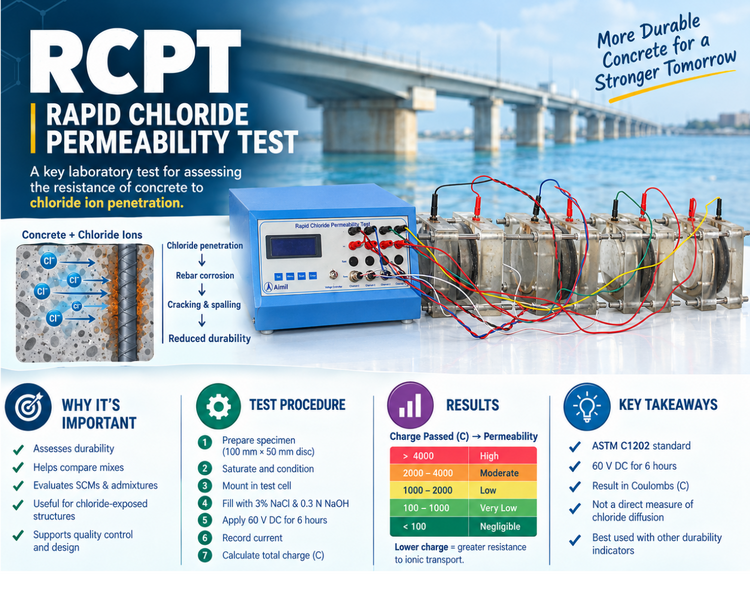
The Rapid Chloride Permeability Test (RCPT) is an important laboratory method for obtaining a rapid indication of the resistance of concrete to chloride-ion penetration.
The test works by placing a conditioned concrete specimen between two electrolyte solutions and applying 60 V DC for six hours. The electrical current passing through the specimen is recorded and converted into the total charge passed in coulombs.
A lower charge generally indicates lower electrical conductance and greater resistance to ionic transport. This makes RCPT useful for comparing concrete mixtures, evaluating durability-related performance and supporting quality-control programs.
At the same time, engineers should understand that RCPT is an electrical indication of ionic transport rather than a direct measurement of chloride diffusion. Factors such as curing, age, pore-solution chemistry, admixtures, SCMs and specimen temperature can influence the result.
For this reason, RCPT is most valuable when it is used as part of a broader concrete durability assessment, rather than as the sole criterion for judging long-term performance.
In simple terms:
Prepare → Saturate → Mount → Add NaCl & NaOH → Apply 60 V → Record Current for 6 h → Calculate Coulombs → Assess Ionic Penetrability
A well-controlled RCPT program can therefore help engineers make more informed decisions about durable concrete for chloride-exposed reinforced concrete structures.
Last edited:

