

Concrete is one of the most widely used construction materials, and its quality depends on several factors, including the water-cement ratio, mix proportions, aggregate properties, and method of placement. Before fresh concrete is placed into formwork, it is important to check whether it has suitable workability for the intended application. The slump test is a simple and widely used field test that helps assess the consistency and workability of fresh concrete.
The test measures how much concrete subsides after a standard-shaped metal cone is lifted away. Although it does not directly measure strength, it provides useful information about the behaviour of fresh concrete during handling, transportation, placing, and compaction. When carried out correctly, the slump test is an important part of routine concrete quality control.
The test measures how much concrete subsides after a standard-shaped metal cone is lifted away. Although it does not directly measure strength, it provides useful information about the behaviour of fresh concrete during handling, transportation, placing, and compaction. When carried out correctly, the slump test is an important part of routine concrete quality control.
Uses and Importance of the Slump Test Procedure
The primary purpose of the slump test is to determine whether fresh concrete has the required consistency for a particular construction activity. Concrete used in a heavily reinforced column may require different workability from concrete placed in a ground-level foundation or pavement.
The test helps site engineers compare successive batches and identify unexpected changes in consistency. For example, a sudden increase in slump may indicate a change in aggregate moisture, water dosage, or admixture content. Similarly, a very low slump can indicate that the concrete may be difficult to compact, particularly in sections containing closely spaced reinforcement.
Regular testing also supports communication between the batching plant and the construction team. However, slump results must always be assessed against the approved mix design and project requirements. A higher slump does not necessarily indicate better-quality concrete, as excessive water can adversely affect strength and durability.
Apparatus Required for Slump Test
The main equipment includes a standard slump cone, a tamping rod, a rigid and level base plate, a measuring scale, and a scoop for handling fresh concrete. The standard cone is 300 mm high, with a bottom diameter of 200 mm and a top diameter of 100 mm. The apparatus should be clean and properly prepared before testing begins.
Procedure for Conducting the Slump Test (Step by Step)
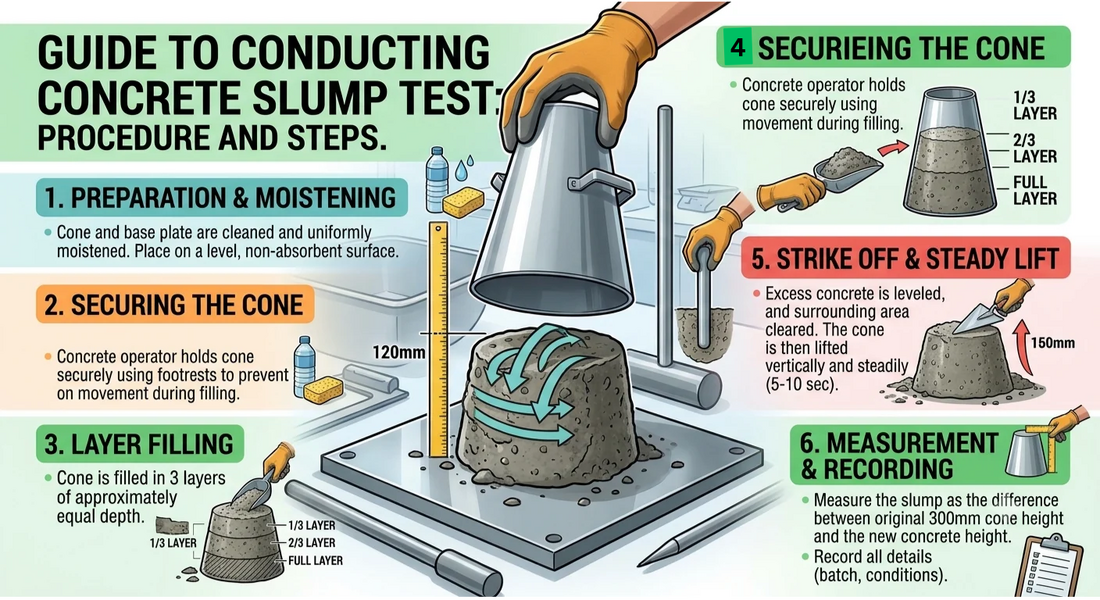
- First, the cone and base plate are cleaned and moistened.
- The cone is placed on a firm, level, non-absorbent surface and held securely to prevent movement during filling.
- Fresh concrete is then placed inside the cone in 3 approximately equal layers, following the commonly used Indian standard procedure.
- Each layer is compacted with 25 strokes of a rounded tamping rod, distributed evenly across the concrete. Care is taken to compact each layer appropriately without disturbing the previous layers excessively.
- After filling, excess concrete is struck off and the top surface is levelled. Any concrete around the base is cleared carefully. The cone is then lifted vertically and steadily, without twisting or sideways movement, generally within five to ten seconds.
- Once the concrete subsides, the slump is measured as the difference between the original cone height of 300 mm and the height of the slumped concrete, using the prescribed measurement method. The observed slump value, along with the batch details and test conditions, should be recorded.
Discussion and Interpretation of Slump Test Results
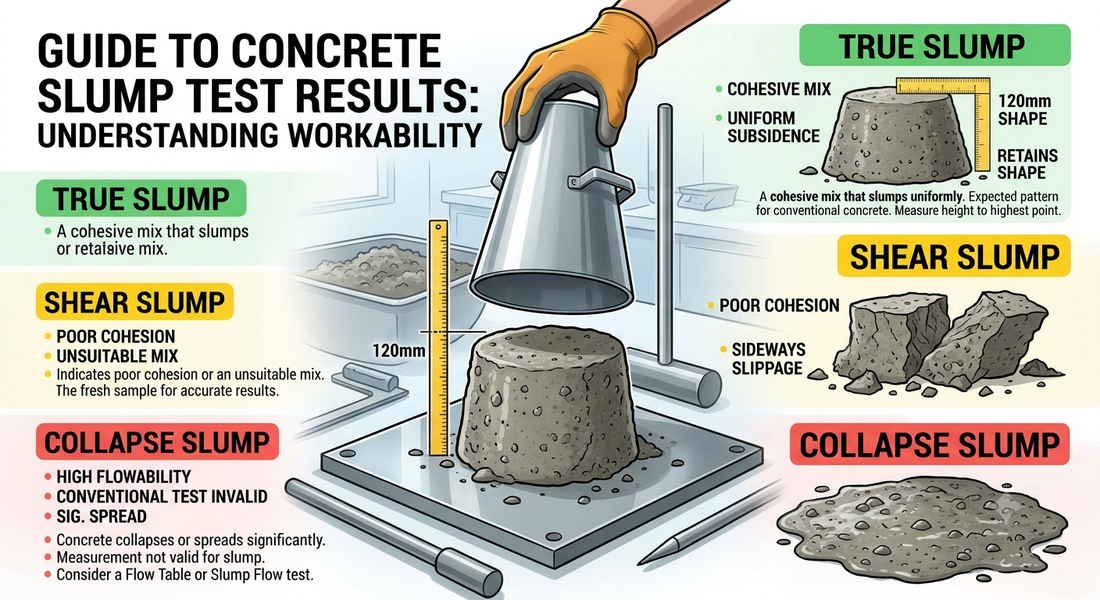
The appearance of the concrete after removing the cone is as important as the measured value. Three common slump patterns are observed.
- A true slump occurs when the concrete subsides relatively uniformly while retaining its general shape. This is generally the expected pattern for a conventional slump test.
- A shear slump occurs when one portion of the concrete mass slips sideways. It may indicate poor cohesion or an unsuitable mix. The test should be repeated with a fresh sample.
- A collapse slump occurs when the concrete collapses or spreads significantly. In this situation, the conventional slump measurement is not considered valid. A suitable test for highly flowable concrete may be required.
Slump values are often classified broadly as low, medium, or high workability. However, there is no single acceptable slump for every concrete mix. The required value depends on the structural element, reinforcement arrangement, placing method, and approved specifications. Slump alone cannot confirm compressive strength; cube or cylinder testing is required for that purpose.
Slump Test Applications in Construction Industry
The slump test is commonly used during concreting of foundations, beams, columns, slabs, and other reinforced concrete elements. It is particularly useful when concrete is delivered by transit mixer, as it allows the receiving team to check consistency before placement.
The test is also valuable in ready-mixed concrete operations, infrastructure projects, and routine site inspections. When results differ from the specified range, the cause should be investigated before any adjustment is made to the mix. Water should never be added casually, as this can change the water-cement ratio and compromise concrete performance.
The slump test is a practical and economical method of checking the workability of fresh concrete. Its value lies in providing a quick indication of consistency and helping identify unusual changes before concrete is placed. Reliable results depend on correct sampling, careful execution, accurate recording, and comparison with the approved project requirements. Used alongside strength testing and other quality-control measures, the slump test contributes to more consistent and dependable concrete construction.
Reference: IS 1199 (Part 2): 2018
*Image is AI generated.

