

The California Bearing Ratio (CBR) test is one of the most widely used tests in highway and pavement engineering for assessing the strength of soil and granular materials used beneath pavements.
For a young civil engineer, the CBR test can initially appear to be just another laboratory test involving a mould, a rammer, water and a loading machine. In practice, however, the result connects directly to one of the most important questions in pavement engineering :
The resulting CBR value of soil is expressed as a percentage.
In India, the laboratory method is covered by IS 2720 (Part 16):1987 – Methods of Test for Soils: Laboratory Determination of CBR, which BIS lists as reviewed in 2021. The same standard allows testing of undisturbed specimens as well as remoulded specimens prepared by static or dynamic compaction.
ASTM also has a dedicated laboratory standard, ASTM D1883-21, for the California Bearing Ratio of laboratory-compacted soils. ASTM states that the test is used to evaluate the potential strength of subgrade, subbase and base-course materials for road and airfield pavement design.
This article explains the CBR test procedure in depth, from sample collection and preparation to compaction, soaking, penetration, calculation, interpretation, applications, field CBR and limitations.
Under the Indian Standard definition, CBR is the ratio, expressed as a percentage, of the force per unit area required to penetrate a soil mass with a 50 mm diameter plunger at a rate of 1.25 mm/min to the corresponding force required for a standard material. The ratio is normally determined at 2.5 mm and 5.0 mm penetration.
“CBR tells us how much resistance a soil offers to penetration compared with a standard reference material.”
It is therefore better to think of CBR as a standardized strength index, rather than as a direct measurement of the ultimate bearing capacity of the soil.
The original idea was relatively simple:
The main purpose of the CBR test is used for evaluating the relative strength of:
The most common application is to determining a subgrade strength parameter that can be used in flexible pavement design.
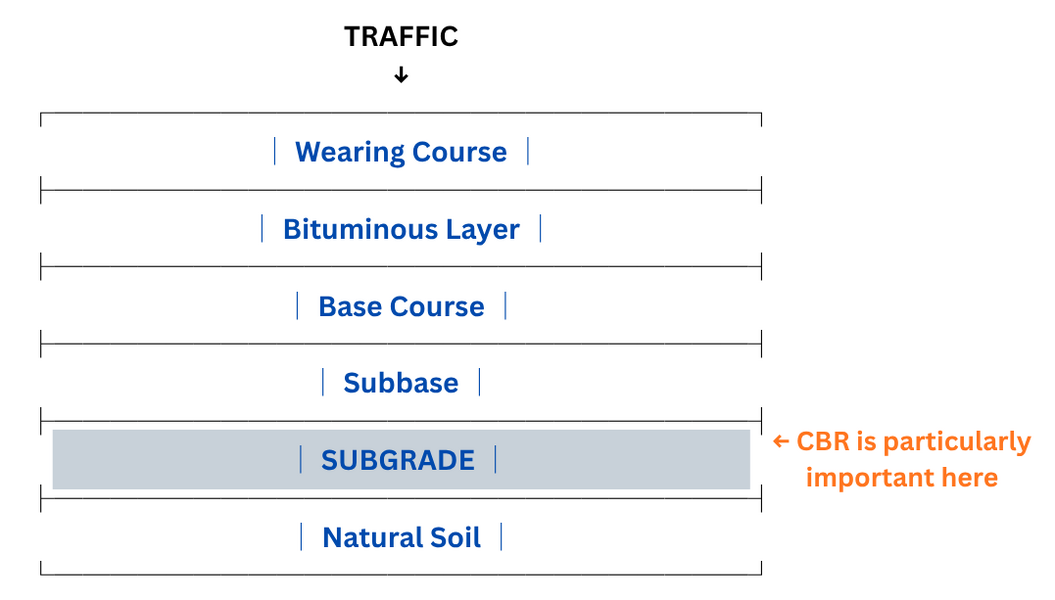
Consider a typical flexible pavement :
The pavement distributes traffic loads over a progressively larger area as the load travels downward.
The subgrade therefore does not simply "carry the wheel load directly." Instead, it receives a stress distribution through the pavement layers.
If the subgrade is weak, the pavement generally requires a different structural configuration than it would over a stronger subgrade.
The term California Bearing Ratio Apparatus is used in two important contexts.
This may involve:
ASTM D1883 is the corresponding laboratory-compacted CBR standard in the ASTM system.
In California bearing ratio insitu testing, the test is performed directly on the soil or pavement material in the field rather than on a remoulded laboratory specimen.
BIS lists IS 2720 (Part 31):1990 – Field Determination of California Bearing Ratio as the relevant Indian Standard.
ASTM also has a separate method for in-place CBR, ASTM D4429. ASTM describes field CBR as useful for evaluating the relative strength of in-place subgrade, subbase and some base-course materials.
An important practical point is that a laboratory CBR and an in-situ CBR should not automatically be expected to be identical. Moisture, density, structure, drainage and construction history can all influence the result.
ASTM specifically warns that changes in water content, density or construction activity can affect the applicability of in-place CBR results.
Equipment and its purpose
The IS method specifies a loading machine capable of maintaining a penetration rate of 1.25 mm/min and a penetration plunger of approximately 50 mm diameter.
The sampling method should preserve the condition needed for the intended test.
For a remoulded laboratory CBR, a representative bulk sample is normally required.
For an undisturbed CBR, the sample must be obtained with much greater care because its natural structure and density are important.
IS 2720 Part 16 specifically provides procedures for undisturbed specimens as well as remoulded specimens.
A laboratory sample record should normally contain:
The objective is not simply "make the soil completely dry."
The objective is to prepare a representative and workable material for controlled moisture adjustment.
Do not crush individual soil particles.
For remoulded laboratory CBR specimens under IS 2720 Part 16, the material is prepared to pass the 19 mm IS sieve. Larger particles require the replacement procedure specified by the standard.
ASTM D1883 similarly states that the laboratory test is primarily intended for materials with maximum particle size less than 19 mm and provides a gradation-modification procedure when larger particles are present. ASTM also warns that modifying the gradation can change the strength characteristics of the material being tested.
A large rock directly beneath the 50 mm plunger could produce an abnormally high or erratic penetration resistance.
This is a very important laboratory principle:
Never alter the soil gradation casually because it can alter the CBR result.
Two important terms are:
OMC — Optimum Moisture Content
The water content at which a specified compaction effort produces the maximum dry density.
MDD — Maximum Dry Density
The maximum dry density obtained from the specified compaction test.
The relevant Indian standards are:
Consider a clayey soil:
A proper report should identify the moisture and density condition and whether the specimen was soaked.
IS 2720 Part 16 itself states that CBR is strongly dependent on the condition of the material at the time of testing.
[w=12%] and the dry mass of soil is: [M_d=5.0kg]
The approximate mass of water required, if the starting soil is treated as dry for this calculation, is:
[M_w = w*M_d]
[M_w = 0.12(5.0)]
[M_w = 0.60 kg]
However, in real laboratory work the existing moisture content must be considered.
If the soil already contains water, the amount of additional water must be adjusted accordingly.
The objective is:
Uniform water content throughout the soil mass.
Poor mixing can produce:
There is no single universal statement that "CBR always means 56 blows."
IS 2720 Part 16 permits:
The soil is placed in the mould and compacted using a displacer disc.
This is useful when a specified density needs to be reproduced directly.
IS 2720 Part 16 notes that static compaction can achieve the required density but requires considerable pressure and may result in density variation with depth.
The CBR procedure refers to compaction methods applicable to the 150 mm diameter mould specified under the relevant light or heavy compaction standards.
For a common heavy-compaction arrangement, the laboratory may use:
N_total=5×56N
N_total=280 blows
This is the arrangement commonly encountered when preparing a CBR specimen using the heavy compaction procedure.
IS 2720 Part 16 explicitly directs dynamic CBR specimen preparation to the applicable compaction procedure for the 150 mm mould.
IS 2720 Part 16 specifies the sequence involving the collar, spacer disc, filter paper, compaction, trimming, removal of the spacer and weighing of the compacted specimen.
The objective is uniform compaction of soil sample
Poor distribution can create:
It represents the soil under the specified as-compacted or field-moisture condition.
For the IS laboratory procedure, the soaking period is 96 hours when the swelling/soaking procedure is used.
Soaked testing is particularly important for moisture-sensitive subgrades because pavement performance can be affected significantly by wet-season conditions.
Dry CBR test condition
CBR = relatively high
Wet CBR test condition
CBR = significantly lower
This can happen because water can reduce the effective resistance of certain soils and alter their structure.
The soaked test therefore provides a controlled way to examine behavior after prolonged water exposure.
It is not simply a "worst-case test" for every soil; the appropriate moisture condition should be selected according to the design standard and project requirements.
The CBR apparatus includes a swell-measuring arrangement.
The initial dial reading is recorded.
After soaking, the final reading is recorded.
The expansion ratio is calculated as:
Expansion Ratio=df−dih×100\boxed{ Expansion\ Ratio= \frac{d_f-d_i}{h}\times100 }
Where:
A CBR of 50% means that, at the specified penetration, the soil requires a load equal to about 50% of the reference load used in the CBR definition.
It does not mean that the soil can safely carry 50% of some road load.
CBR is an index used for pavement/subgrade characterization and design.
Therefore, surcharge weights are used to represent the effect of pavement materials above the soil specimen.
IS 2720 Part 16 specifies that surcharge loading should represent the weight/intensity associated with the base material and pavement, with the soaked test using the same surcharge during penetration.
The penetration plunger is positioned centrally.
The plunger is approximately 50 mm diameter
The penetration rate is 1.25 mm/min
The maximum load and penetration are also recorded if the maximum occurs before 12.5 mm.
CBR=Test load ×100/ Standard load
For the Indian Standard procedure, the standard loads are :
P2.5=420 kgf
Then:
CBR_2.5 = (420/1370)×100
CBR_2.5=30.66%
Now suppose: penetration is 5mm
P_5=700 kgf
Then:
CBR_5=(700/2055)×100
CBR_5= =34.06%
Because the 5 mm result is higher than the 2.5 mm result, the Indian Standard requires the test to be repeated. If the same relationship is reproduced, the 5 mm value is used.
For a young civil engineer, the CBR test can initially appear to be just another laboratory test involving a mould, a rammer, water and a loading machine. In practice, however, the result connects directly to one of the most important questions in pavement engineering :
How well can the subgrade support the pavement and traffic loads placed above it?
The CBR test is essentially a penetration test. A standard circular plunger is pushed into a prepared soil specimen at a controlled rate, and the load required to produce specified penetrations is measured. The measured resistance is compared with the resistance of a standard crushed-rock material.The resulting CBR value of soil is expressed as a percentage.
In India, the laboratory method is covered by IS 2720 (Part 16):1987 – Methods of Test for Soils: Laboratory Determination of CBR, which BIS lists as reviewed in 2021. The same standard allows testing of undisturbed specimens as well as remoulded specimens prepared by static or dynamic compaction.
ASTM also has a dedicated laboratory standard, ASTM D1883-21, for the California Bearing Ratio of laboratory-compacted soils. ASTM states that the test is used to evaluate the potential strength of subgrade, subbase and base-course materials for road and airfield pavement design.
This article explains the CBR test procedure in depth, from sample collection and preparation to compaction, soaking, penetration, calculation, interpretation, applications, field CBR and limitations.
What is the California Bearing Ratio?
The California Bearing Ratio is a penetration-resistance index used to characterize pavement subgrade, subbase and certain base-course materials.Under the Indian Standard definition, CBR is the ratio, expressed as a percentage, of the force per unit area required to penetrate a soil mass with a 50 mm diameter plunger at a rate of 1.25 mm/min to the corresponding force required for a standard material. The ratio is normally determined at 2.5 mm and 5.0 mm penetration.
“CBR tells us how much resistance a soil offers to penetration compared with a standard reference material.”
It is therefore better to think of CBR as a standardized strength index, rather than as a direct measurement of the ultimate bearing capacity of the soil.
Why was the California Bearing Ratio CBR test developed?
The test originated from work associated with the California State Highway Department and was developed to provide a practical way of evaluating pavement-supporting materials.The original idea was relatively simple:
- Take the material that will support a pavement.
- Apply a standardized penetration.
- Measure the resistance.
- Compare that resistance with a standard crushed material.
- Use the resulting index in pavement design.
What is the California Bearing Ratio CBR test used for ?
The main purpose of the CBR test is used for evaluating the relative strength of:
- Subgrade soil
- Granular subgrade
- Subbase materials
- Certain base-course materials
- Recycled pavement materials, where the applicable standard permits their evaluation
The most common application is to determining a subgrade strength parameter that can be used in flexible pavement design.
Where does California Bearing Ratio Apparatus fit into a road?
Consider a typical flexible pavement :
The pavement distributes traffic loads over a progressively larger area as the load travels downward.
The subgrade therefore does not simply "carry the wheel load directly." Instead, it receives a stress distribution through the pavement layers.
If the subgrade is weak, the pavement generally requires a different structural configuration than it would over a stronger subgrade.
Laboratory California Bearing Ratio Apparatus and In-Situ California Bearing Ratio Apparatus
The term California Bearing Ratio Apparatus is used in two important contexts.
Laboratory California Bearing Ratio Apparatus
A soil sample is brought to the laboratory and prepared under controlled conditions.This may involve:
- Controlled moisture content
- Controlled dry density
- Controlled compaction
- Controlled soaking
- Standard penetration rate
ASTM D1883 is the corresponding laboratory-compacted CBR standard in the ASTM system.
Laboratory California Bearing Ratio Test Advantage
The engineer can control the test conditions.Laboratory California Bearing Ratio Test Limitation
The laboratory specimen may not exactly reproduce the soil condition existing in the field.California Bearing Ratio In-Situ
In California bearing ratio insitu testing, the test is performed directly on the soil or pavement material in the field rather than on a remoulded laboratory specimen.
BIS lists IS 2720 (Part 31):1990 – Field Determination of California Bearing Ratio as the relevant Indian Standard.
ASTM also has a separate method for in-place CBR, ASTM D4429. ASTM describes field CBR as useful for evaluating the relative strength of in-place subgrade, subbase and some base-course materials.
Difference between Laboratory California Bearing Ratio Test and In-situ California Bearing Ratio Test
| Sample prepared in laboratory | Tested in the field |
| Moisture can be controlled | Actual field moisture |
| Density can be controlled | Existing field density |
| Soaking can be controlled | Field condition governs unless procedure specifies otherwise |
| Highly standardized specimen | Represents actual location more directly |
| Useful for design studies | Useful for field evaluation/verification |
Instrument used - Laboratory California Bearing Ratio Apparatus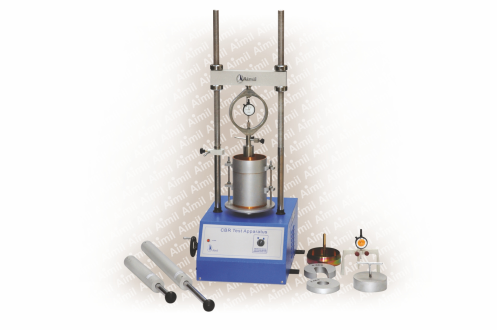 | Instrument used - In-situ California Bearing Ratio Apparatus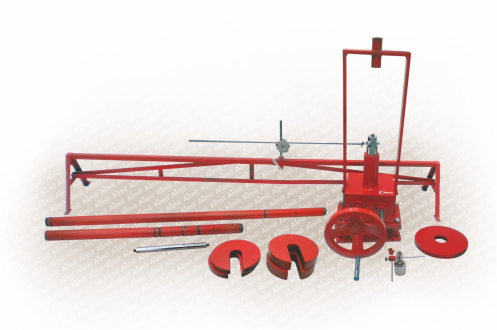 |
An important practical point is that a laboratory CBR and an in-situ CBR should not automatically be expected to be identical. Moisture, density, structure, drainage and construction history can all influence the result.
ASTM specifically warns that changes in water content, density or construction activity can affect the applicability of in-place CBR results.
California Bearing Ratio Test Apparatus
The main equipment includes:Equipment and its purpose
- CBR mould - Holds the soil specimen
- Base plate - Supports the mould
- Extension collar - Provides additional height during compaction
- Spacer disc - Creates the required specimen arrangement
- Compaction rammer - Compacts the soil
- Filter paper - Separates soil from perforated components
- Surcharge weights - Simulate pavement overburden
- Expansion measuring device - Measures swelling
- CBR loading machine - Applies penetration load
- Penetration plunger - Penetrates the soil
- Proving ring/load cell - Measures load
- Dial gauge/displacement gauge - Measures penetration
- Sieves - Prepare soil particle size
- Weighing balance - Determines sample/mould mass
- Mixing tray/bowl - Mixing soil and water
- Soaking tank - Soaked CBR preparation
The IS method specifies a loading machine capable of maintaining a penetration rate of 1.25 mm/min and a penetration plunger of approximately 50 mm diameter.
Soil Sample Collection in the Field
Depending on the soil and investigation requirement, samples may be collected by:- Trial pits
- Boreholes
- Augering
- Cutting from exposed subgrade
- Other appropriate geotechnical sampling methods
The sampling method should preserve the condition needed for the intended test.
For a remoulded laboratory CBR, a representative bulk sample is normally required.
For an undisturbed CBR, the sample must be obtained with much greater care because its natural structure and density are important.
IS 2720 Part 16 specifically provides procedures for undisturbed specimens as well as remoulded specimens.
Sample Identification
Every sample should be properly identified.A laboratory sample record should normally contain:
- Project name
- Sample number
- Chainage
- Location
- Depth
- Soil description
- Date of collection
- Sampling method
- Natural moisture condition
- Intended test condition
Air drying of soil sample
For preparation of a remoulded laboratory specimen, the soil is generally prepared by drying sufficiently to allow lumps to be broken down and the material to be mixed uniformly.The objective is not simply "make the soil completely dry."
The objective is to prepare a representative and workable material for controlled moisture adjustment.
Breaking Soil Lumps
After drying, soil lumps are gently broken.Do not crush individual soil particles.
Sieving the soil sample
This is one of the most important sample-preparation steps.For remoulded laboratory CBR specimens under IS 2720 Part 16, the material is prepared to pass the 19 mm IS sieve. Larger particles require the replacement procedure specified by the standard.
ASTM D1883 similarly states that the laboratory test is primarily intended for materials with maximum particle size less than 19 mm and provides a gradation-modification procedure when larger particles are present. ASTM also warns that modifying the gradation can change the strength characteristics of the material being tested.
Why is soil sample sieving required?
Because the CBR mould and plunger have a standardized geometry.A large rock directly beneath the 50 mm plunger could produce an abnormally high or erratic penetration resistance.
What if Material is Retained on the 19 mm Sieve?
The retained oversized fraction is replaced with an equal mass of material passing the 19 mm sieve and retained on the 4.75 mm sieve, as specified by the Indian procedure.This is a very important laboratory principle:
Never alter the soil gradation casually because it can alter the CBR result.
Determination of Optimum Moisture Content (OMC) and Maximum Dry Density (MDD)
Before preparing the CBR specimen, the engineer needs to establish the moisture-density relationship when the test specification calls for it.Two important terms are:
OMC — Optimum Moisture Content
The water content at which a specified compaction effort produces the maximum dry density.
MDD — Maximum Dry Density
The maximum dry density obtained from the specified compaction test.
The relevant Indian standards are:
- IS 2720 Part 7 — light compaction
- IS 2720 Part 8 — heavy compaction
Why Optimum Moisture Content Matters in CBR ?
CBR is highly dependent on the condition of the soil at the time of testing.Consider a clayey soil:
- Very dry - Hard/difficult to compact
- OMC - Dense condition may be achieved
- Very wet - Soft/weakened condition
A proper report should identify the moisture and density condition and whether the specimen was soaked.
IS 2720 Part 16 itself states that CBR is strongly dependent on the condition of the material at the time of testing.
Preparing the soil sample for compaction
Suppose the required water content is:[w=12%] and the dry mass of soil is: [M_d=5.0kg]
The approximate mass of water required, if the starting soil is treated as dry for this calculation, is:
[M_w = w*M_d]
[M_w = 0.12(5.0)]
[M_w = 0.60 kg]
However, in real laboratory work the existing moisture content must be considered.
If the soil already contains water, the amount of additional water must be adjusted accordingly.
Moisture Mixing
Water should be added gradually to the soil sample and distributed uniformly.The objective is:
Uniform water content throughout the soil mass.
Poor mixing can produce:
- Wet pockets
- Dry pockets
- Non-uniform density
- Unreliable CBR
CBR Specimen Compaction
This is one of the most misunderstood parts of the test.There is no single universal statement that "CBR always means 56 blows."
IS 2720 Part 16 permits:
- Static compaction
- Dynamic compaction
- Field density
- Maximum dry density
- Another specified density
- Optimum water content
- Field moisture content
- Another specified value.
Static Compaction
In static compaction, the required wet soil mass is calculated to produce the desired density within the standard mould volume.The soil is placed in the mould and compacted using a displacer disc.
This is useful when a specified density needs to be reproduced directly.
IS 2720 Part 16 notes that static compaction can achieve the required density but requires considerable pressure and may result in density variation with depth.
Dynamic Compaction
Dynamic compaction uses a standard rammer and controlled drops.The CBR procedure refers to compaction methods applicable to the 150 mm diameter mould specified under the relevant light or heavy compaction standards.
For a common heavy-compaction arrangement, the laboratory may use:
- Rammer mass: approximately 4.9 kg
- Drop height: approximately 450 mm
- Number of layers: 5
- Blows per layer: 56
N_total=5×56N
N_total=280 blows
This is the arrangement commonly encountered when preparing a CBR specimen using the heavy compaction procedure.
IS 2720 Part 16 explicitly directs dynamic CBR specimen preparation to the applicable compaction procedure for the 150 mm mould.
How to Perform Dynamic Compaction in the CBR Mould
A typical sequence is:Step 1 - Fix the CBR mould to its base plate.
Step 2 - Install the extension collar.
Step 3 - Place the spacer disc.
Step 4 - Place coarse filter paper over the spacer disc.
Step 5 - Divide the prepared soil into approximately equal portions.
Step 6 - Place the first layer.
Step 7 - Compact using the specified rammer and number of blows.
Step 8 - Scarify the surface lightly if required by the compaction procedure before placing the next layer.
Step 9 - Place the next layer.
Step 10 - Repeat until all layers are completed.
Step 11 - Remove the collar.
Step 12 - Trim the soil flush with the mould.
Step 13 - Patch any significant voids left by coarse particles using suitable smaller material.
Step 14 - Remove the spacer disc.
Step 15 - Record the mould + soil mass.
IS 2720 Part 16 specifies the sequence involving the collar, spacer disc, filter paper, compaction, trimming, removal of the spacer and weighing of the compacted specimen.
Why Must the Rammer Blows Be Distributed?
The rammer should not repeatedly strike the same location.The objective is uniform compaction of soil sample
Poor distribution can create:
- Local high-density zones
- Non-uniform void ratio
- Non-uniform moisture distribution
- Variable penetration resistance
Soaked and Unsoaked California Bearing Ratio
There are two important testing conditions.Unsoaked California Bearing Ratio test condition
The penetration test is performed without the standard soaking period.It represents the soil under the specified as-compacted or field-moisture condition.
Soaked California Bearing Ratio test condition
The compacted specimen is immersed in water before penetration.For the IS laboratory procedure, the soaking period is 96 hours when the swelling/soaking procedure is used.
Soaked testing is particularly important for moisture-sensitive subgrades because pavement performance can be affected significantly by wet-season conditions.
Why Do We Soak the Specimen?
Imagine two identical subgrade soils.Dry CBR test condition
CBR = relatively high
Wet CBR test condition
CBR = significantly lower
This can happen because water can reduce the effective resistance of certain soils and alter their structure.
The soaked test therefore provides a controlled way to examine behavior after prolonged water exposure.
It is not simply a "worst-case test" for every soil; the appropriate moisture condition should be selected according to the design standard and project requirements.
Swell Measurement
During soaking, expansive soils may increase in volume.The CBR apparatus includes a swell-measuring arrangement.
The initial dial reading is recorded.
After soaking, the final reading is recorded.
The expansion ratio is calculated as:
Expansion Ratio=df−dih×100\boxed{ Expansion\ Ratio= \frac{d_f-d_i}{h}\times100 }
Where:
- dfd_f = final dial reading
- did_i = initial dial reading
- hh = initial specimen height
Soaking Procedure
A simplified sequence is:- Place filter paper over the specimen.
- Install the perforated plate and expansion stem.
- Apply the required surcharge.
- Place the mould in the soaking tank.
- Allow water access to the specimen.
- Record the initial dial reading.
- Maintain the water level.
- Keep the specimen immersed for 96 hours.
- Record the final dial reading.
- Remove the mould.
- Remove free water.
- Allow the specimen to drain as specified.
- Weigh the soaked specimen where required.
- Proceed to the penetration test.
What does 50% actually mean ?
This is the part that's important in real engineering.A CBR of 50% means that, at the specified penetration, the soil requires a load equal to about 50% of the reference load used in the CBR definition.
It does not mean that the soil can safely carry 50% of some road load.
CBR is an index used for pavement/subgrade characterization and design.
Why Are Surcharge Weights Used in CBR test?
The real pavement places an overburden pressure on the subgrade.Therefore, surcharge weights are used to represent the effect of pavement materials above the soil specimen.
IS 2720 Part 16 specifies that surcharge loading should represent the weight/intensity associated with the base material and pavement, with the soaked test using the same surcharge during penetration.
Penetration Test
After specimen preparation and soaking, the mould is placed in the CBR loading machine.The penetration plunger is positioned centrally.
The plunger is approximately 50 mm diameter
The penetration rate is 1.25 mm/min
The maximum load and penetration are also recorded if the maximum occurs before 12.5 mm.
California Bearing Ratio Formula
The California bearing ratio formula is :CBR=Test load ×100/ Standard load
For the Indian Standard procedure, the standard loads are :
- 2.5 mm Penetration at Standard load 1370 kgf
- 5.0 mm Penetration at Standard load 2055 kgf
- 70 kg/cm² at 2.5 mm
- 105 kg/cm² at 5.0 mm
CBR Calculation Example
Now suppose: penetration is 2.5mmP2.5=420 kgf
Then:
CBR_2.5 = (420/1370)×100
CBR_2.5=30.66%
Now suppose: penetration is 5mm
P_5=700 kgf
Then:
CBR_5=(700/2055)×100
CBR_5= =34.06%
Because the 5 mm result is higher than the 2.5 mm result, the Indian Standard requires the test to be repeated. If the same relationship is reproduced, the 5 mm value is used.
Determine the Final CBR Calculation
- The CBR values at 2.5 mm and 5 mm are compared.
- For the IS procedure, the 2.5 mm value is normally adopted when it is higher than the 5 mm value.
- If the 5 mm value is higher, the test is repeated. If the same relationship is obtained in the repeat test, the 5 mm value is adopted according to the standard.
Last edited:

