

Why Soundness Testing is Important in construction industry ?
When cement hydrates and sets, a small number of compounds continue to react with water over weeks or even months. If the cement contains excess free lime (CaO), magnesia (MgO), or sulfates beyond permissible limits, this delayed reaction causes the paste to expand — after it has already bonded with aggregate and reinforcement. The result is internal stress that cracks concrete from the inside out, often with no visible warning until structural damage is severe.The Le Chatelier apparatus test is the standard laboratory method used across India, Nepal, Bangladesh, and Sri Lanka to detect this risk before cement ever reaches a construction site. It is mandated under IS 4031 (Part 3) – 1988, and any batch that fails the 10 mm expansion limit must be rejected outright.
Key definition:
Soundness is the property of cement that describes its ability to maintain a stable volume after setting. An unsound cement expands, cracks its surrounding structure, and ultimately compromises structural integrity.
The Le Chatelier Apparatus — Construction and Components
The apparatus is deceptively simple: a small split brass cylinder that holds a cement paste specimen while two slender indicator arms measure any change in diameter. Its simplicity is deliberate — the test needs to be reproducible across hundreds of different laboratories with minimal equipment variation.| Component | Material | Function |
| Split cylindrical mould | Brass | Holds cement paste; splits to allow expansion measurement |
| Indicator arms (pointers) | Brass | Measure separation distance before and after heating |
| Glass plates (x2) | Glass | Cover the mould during initial curing phase |
| Water bath / boiling tank | Stainless steel | Provides controlled temperature environment for the test |
The Le Chatelier Apparatus Principle
The test accelerates the long-term expansion behaviour of cement by exposing it to boiling water. Under normal curing conditions, the reactions that cause unsoundness take months to manifest; boiling compresses that timeline to hours. The indicator arms of the apparatus translate any volumetric expansion of the cement paste into a measurable linear distance, giving the technician a clear, quantitative result.The three main culprits behind unsoundness are free lime, magnesia, and excess sulfates. Of these, free lime is the most common in poorly manufactured cement and the primary target of this test. Magnesia-related expansion develops more slowly and at higher temperatures — which is why the autoclave test is sometimes used as a supplementary method for detailed analysis.
Applicable Standards for Le Chatelier soundness test
- IS 4031 (Part 3) – 1988 - primary standard for hydraulic cement 10 mm max. applicable in India and South Asia.
- ASTM C151 - Autoclave method, more sensitive to MgO 0.8% max. applicable in United States
- BS EN 196-3 - Le Chatelier method aligned with EN codes 10 mm max. applicable in European Union country and wordwide
Step-by-Step Test Procedure of soundness test of cement using the Le Chatelier Appratus
The procedure below conforms to IS 4031 (Part 3) – 1988. Each step is critical — deviations in water ratio, curing temperature, or heating rate will produce unreliable results and cannot be used as a basis for accepting or rejecting a cement batch.- Prepare the Cement Paste - Weigh a representative cement sample. Add water at 0.78 times the standard consistency water requirement (determined separately per IS 4031 Part 4). Mix thoroughly for 3–5 minutes until a uniform, lump-free paste is obtained. Work quickly — cement begins to stiffen and the paste must be placed before initial set.
- Fill and Assemble the Mould - Lightly coat the inside of the split mould with a thin film of oil to prevent adhesion. Place the mould on a lightly oiled glass plate. Fill completely with the cement paste, taking care to eliminate air pockets by gentle tapping. Cover with the second glass plate.
- Initial Curing at Ambient Temperature - Submerge the fully assembled mould in a water bath maintained at 27 ± 2°C. Leave undisturbed for 24 hours. This allows the cement to reach initial set and develop sufficient strength to hold its shape during the subsequent heating phase.
- Record Initial Indicator Reading - Remove the mould from the water bath. Using a steel rule or vernier caliper, measure and record the distance between the tips of the two indicator arms (D1). Ensure the measurement is taken at the same point each time for consistency.
- Heating Phase — Bring to Boil - Place the mould back in the water bath. Gradually raise the temperature to boiling over a period of 25 to 30 minutes. A consistent heating rate is important — sudden temperature spikes can cause thermal cracking unrelated to cement unsoundness.
- Sustained Boiling - Maintain at a vigorous boil for exactly 3 hours. Keep the mould fully submerged throughout. The extended boiling period forces accelerated hydration of any free lime or other reactive compounds present in the cement.
- Cool and Take Final Reading - Remove the apparatus from the water bath and allow it to cool naturally to room temperature — do not force-cool. Once cool, measure and record the distance between the indicator arm tips again (D2). Calculate expansion as D2 minus D1.
Calculating and Interpreting Results of the Le Chatelier test for cement soundness testing
Expansion (mm) = D2 (final reading) – D1 (initial reading)If the expansion is 10 mm or less
- The cement sample passed the cement soundness testing using Le Chatelier test
- Cement is approved for use.
- Document and retain the result.
If the expansion is greater than 10 mm or less
- The cement sample failed the cement soundness testing using Le Chatelier test.
- Cement sample is rejected.
- Do not use on-site.
- Notify supplier and retest from a fresh sample.
Critical Precautions for Le Chatelier test's Accurate Results
This test is straightforward in principle, but small procedural errors introduce significant measurement error.The following precautions should be observed without exception:
- Use a fresh, representative sample. Cement that has partially hydrated due to moisture exposure will yield artificially low expansion readings, potentially masking an unsound batch.
- Control the heating rate strictly. Reaching boiling in less than 25 minutes or more than 30 minutes alters the test kinetics. Use a thermometer and consistent heat source.
- Eliminate air bubbles when filling the mould. Voids in the paste introduce measurement uncertainty and can cause false cracking during heating.
- Take all measurements at the same reference point. The indicator arm tips must be measured at the same position each time — small angular differences produce large reading errors.
- Keep the apparatus clean and undamaged. A bent indicator arm, corroded mould, or chipped glass plate will compromise the split and render the result invalid.
Comparison between Le Chatelier Test and Autoclave Test
Both tests assess cement soundness, but they target different failure mechanisms and suit different testing environments.Aspect | Le Chatelier Test | Autoclave Test (ASTM C151) |
| Standard | IS 4031 (Part 3), BS EN 196-3 | ASTM C151 |
| Primary target | Free lime (CaO) | Free lime and magnesia (MgO) |
| Test medium | Boiling water at 100°C | High-pressure steam at 215°C |
| Duration | ~28 hours total | ~24 hours total |
| Equipment cost | Low — brass mould and water bath | High — pressurised autoclave required |
| Best suited for | Routine site/lab QC in South Asia | Detailed certification, international projects |
| Limitation | Cannot reliably detect MgO expansion | Requires specialised equipment and training |
For most construction projects in India and neighbouring countries, the Le Chatelier test is sufficient and mandated. For large infrastructure projects, export-specification concrete, or cements with known high MgO content, supplementing with the autoclave test is advisable.
Le Chatelier cement soundness Test Frequently Asked Questions
Le Chatelier cement soundness Test at a glance
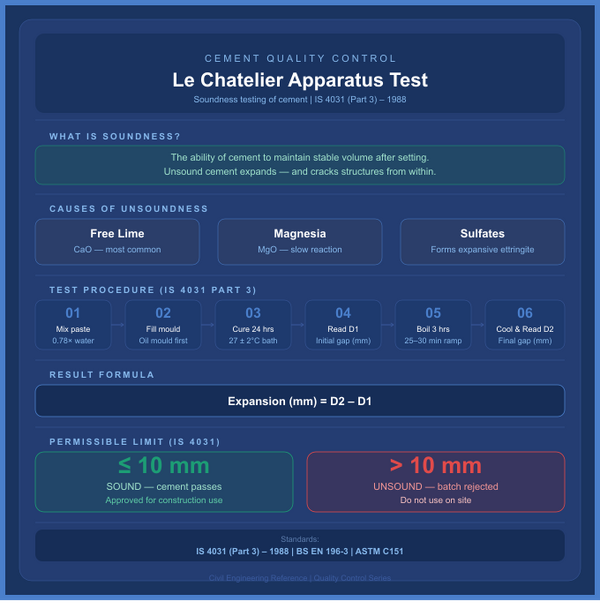
What is the Le Chatelier apparatus used for?
It measures the soundness of cement — specifically, the expansion of a cement paste specimen when subjected to accelerated curing in boiling water. The result indicates whether the cement will remain volumetrically stable after setting in a structure.What is the permissible expansion limit under IS code?
IS 4031 (Part 3) – 1988 sets the limit at 10 mm. Any expansion exceeding this value means the cement batch is unsound and must be rejected.Why is the test done in boiling water?
Boiling water accelerates the hydration of free lime and other reactive compounds that would otherwise take months to fully react at ambient temperature. This allows a result to be obtained in roughly 24 hours rather than waiting for long-term in-situ observation.Can a cement batch be used if expansion is slightly above 10 mm?
No. The 10 mm limit is a hard threshold under IS standards. There is no tolerance or grace margin — a batch that fails must be rejected regardless of how close the result is to the limit.What are the three causes of unsoundness in cement?
The primary causes are: (1) excess free lime (CaO), which expands during delayed hydration; (2) excess magnesia (MgO), which reacts even more slowly than free lime; and (3) excess sulfates, which form expansive ettringite when reacting with hydrated calcium aluminates.The Le Chatelier apparatus test remains the most practical and widely adopted method for cement soundness testing across South Asia — and for good reason. It is low-cost, rapid, reproducible, and directly aligned with IS, EN, and other major standards. Understanding its principle, executing the procedure correctly, and interpreting results without ambiguity are foundational skills for any quality control technician, lab engineer, or site supervisor working with structural concrete.
Cement is the starting point of every concrete structure. Catching an unsound batch in the laboratory costs a few hours and the price of the sample. Missing it on-site can cost decades of structural integrity. This test exists precisely to prevent that outcome — use it accordingly.
Share it with your team or link to it from your site. For questions on cement quality testing or IS code compliance, consult a certified laboratory or structural engineer.

