

Sieve Analysis Test Apparatus (Grain Size Distribution)
Sieve Analysis Test Procedure
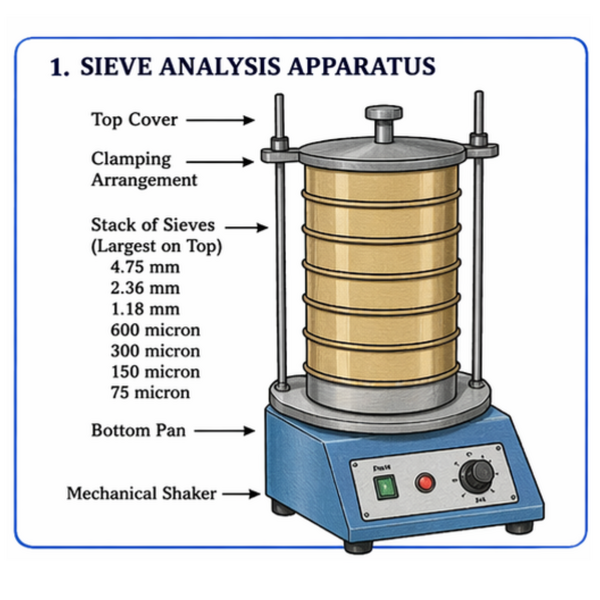
The sieve analysis test begins by collecting a representative soil sample, which is oven-dried to remove natural moisture.The dried sample is then gently broken down so that individual particles are separated without crushing them.
A stack of standard sieves is arranged in descending order of size, typically from 4.75 mm down to 75 microns, as specified by IS 2720 (Part 4) under the Bureau of Indian Standards.
The soil is placed on the top sieve, and the stack is fixed in a mechanical sieve shaker. The shaker is operated for about 10 to 15 minutes, allowing particles to segregate according to size.
After completion, the material retained on each sieve is weighed, and the percentage passing through each sieve is calculated.
These values are used to plot a grain size distribution curve on semi-logarithmic paper.
What the Sieve Analysis Test Helps Determine
This test determines the gradation and particle size distribution of soil.It helps identify whether the soil is well-graded, uniformly graded, or gap-graded.
These characteristics directly influence permeability, compaction efficiency, and shear strength behavior.
Industry Applications of Sieve analysis Test
Sieve analysis is extensively used in road construction, concrete mix design, railway ballast selection, and drainage system design.It ensures that soil or aggregates meet required specifications for strength and durability in construction projects.
Price of Sieve analysis setup (Sieve set) in India
The cost of a sieve analysis setup depends mainly on whether you choose a manual or motorized sieve shaker, along with the number and quality of sieves.A basic motorized sieve shaker like Digital Laboratory Sieve Shaker typically costs around ₹15,000–₹30,000 in india, while higher-end or imported units can go up to ₹50,000–₹1,00,000 in india depending on automation and build quality.
Liquid Limit & Plastic Limit Tests (Atterberg Limits)
Liquid Limit & Plastic Limit Tests Atterberg Limits Test Procedure
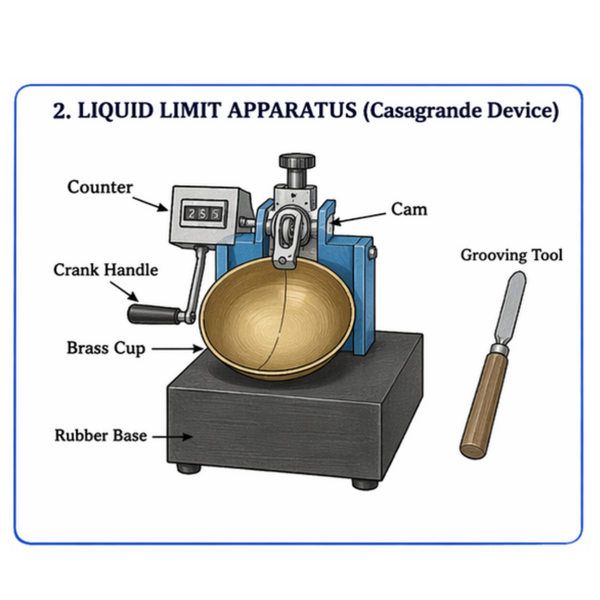
For the liquid limit test, soil passing a 425-micron sieve is mixed with water to form a uniform paste. This paste is placed in the brass cup of the Casagrande device and divided using a standard grooving tool.
The crank is rotated at a constant speed, and the number of blows required to close the groove over a 12 mm length is recorded.
The test is repeated at different moisture contents, and a flow curve is plotted to determine the liquid limit at 25 blows.
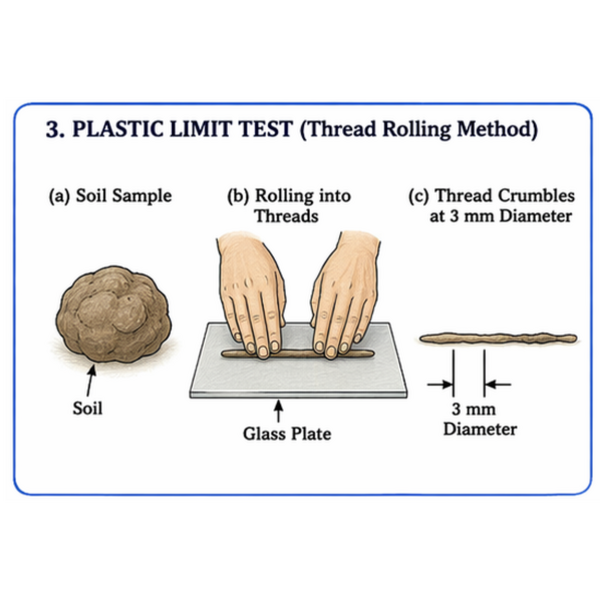
For the plastic limit test, a portion of the same soil is rolled into threads of 3 mm diameter on a glass plate.
When the thread begins to crumble at this diameter, the moisture content is determined. Both tests follow IS 2720 (Part 5) specified by the Bureau of Indian Standards.
What the Atterberg Limits Helps Determine
These tests define the consistency limits of soil.The liquid limit indicates the boundary between liquid and plastic states, while the plastic limit defines the transition from plastic to semi-solid state.
The difference between them gives the Plasticity Index (PI), which is crucial for soil classification and predicting behavior like swelling, shrinkage, and compressibility.
Industry Applications of Atterberg Limits
Atterberg limits are widely used in foundation design, road subgrade evaluation, embankment construction, and landfill engineering.They are especially important for clayey soils, where moisture variation significantly impacts performance.
Price of Atterberg limits Test apparatus in India
The Atterberg limits setup is one of the most affordable yet essential investments for any geotechnical lab. A standard Casagrande device like Casagrande Liquid Limit Apparatus is available in the range of ₹2,500–₹5,000 depending on build quality and whether it includes a blow counter.Additional accessories such as grooving tools, glass plates, and moisture containers may cost another ₹1,000–₹3,000. So, the total setup cost generally falls between ₹4,000 and ₹8,000.
3. Proctor Compaction Test (Compaction Apparatus)
Proctor Compaction Test Procedure
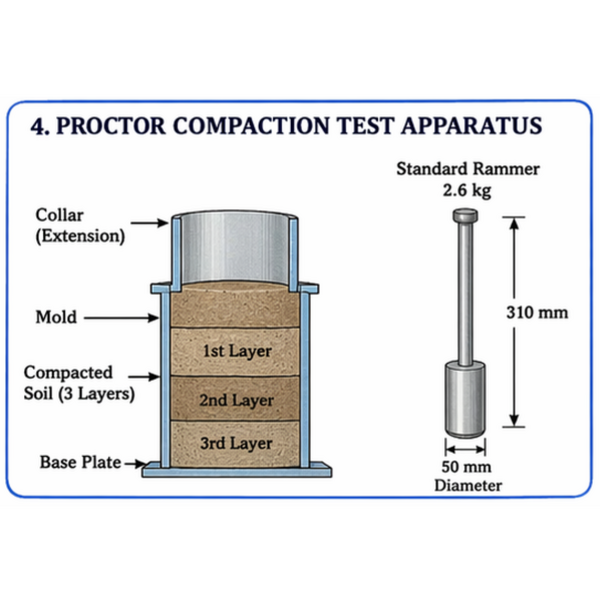
In this test, air-dried soil is mixed with a known amount of water and placed into a cylindrical mold in three equal layers.Each layer is compacted using a standard rammer with a specified number of blows.
After compaction, the bulk weight of the soil is measured, and a sample is taken to determine moisture content. The procedure is repeated with increasing water content.
Dry density values are calculated for each trial, and a curve is plotted between dry density and moisture content.
The peak of this curve gives the Maximum Dry Density (MDD), and the corresponding moisture content is the Optimum Moisture Content (OMC), as per IS 2720 (Part 7) from the Bureau of Indian Standards.
What the Proctor Compaction Test Helps Determine
This test determines the optimum moisture level required for maximum soil compaction and the maximum achievable dry density.These parameters are essential for ensuring soil stability and load-bearing capacity.
Proctor Compaction Test Industry Applications
The Proctor test is critical in road construction, embankments, earth dams, and backfilling operations. Field compaction is controlled based on this test, ensuring that soil achieves the required density for structural safety.
Price of Proctor Compaction Test Apparatus in india
A standard setup like Proctor Compaction Test Apparatus typically costs between ₹10,000 and ₹30,000 in india depending on whether it is manual or semi-automatic.
Higher-end models with automatic compactors can go beyond 50,000 INR
4. Sand Replacement Test
Test Procedure Sand Replacement Test
The sand replacement test is used to determine in-situ field density. A small pit is dug at the test location, and the excavated soil is collected and weighed.A sand pouring cylinder filled with uniformly graded sand is placed over the pit, and sand is allowed to fill the hole.
The volume of the hole is determined based on the weight of sand required to fill it. The dry density of soil is then calculated by dividing the weight of excavated soil by the volume of the pit.
This procedure follows IS 2720 (Part 28) guidelines from the Bureau of Indian Standards.
What the Sand Replacement Test Helps Determine
This test determines the in-place dry density of soil in the field.It is used to verify whether the compaction achieved on-site meets the required specifications.
Industry Applications Sand Replacement Test
Sand replacement is widely used in road construction, embankments, and earthwork projects.It is essential for quality control during construction, ensuring that field compaction matches laboratory results like MDD.
Price of sand replacement test setup in India
The sand replacement test setup is relatively affordable and highly useful for field density measurement. A standard apparatus like Sand Pouring Cylinder Apparatus typically costs between ₹2,500 and ₹6,000 depending on size and material quality. Even with high-quality components, the total cost rarely exceeds ₹8,000–₹10,000.5. Core Cutter Test
Core Cutter Test Procedure
In the core cutter test, a cylindrical steel cutter is driven into the soil using a rammer.The cutter is carefully excavated, and the soil sample inside is trimmed flush with the ends.
The weight of the soil-filled cutter is recorded, and the volume of the cutter is known.
A moisture content sample is taken to determine dry density.
The dry density is calculated by dividing the dry weight of soil by the volume of the cutter.
This method is specified in IS 2720 (Part 29) by the Bureau of Indian Standards.
What the Test Helps Determine
The core cutter test determines the field density and degree of compaction of soil. It is a quick and reliable method for cohesive soils.Industry Applications of Core Cutter Test Procedure
This test is commonly used in road works, canal linings, and small construction projects. It is preferred for routine field checks where quick results are required and soil conditions are suitable.Price of Core Cutter Soil Testing Apparatus in India
The core cutter test is one of the most economical soil testing methods available. A basic setup like Core Cutter Soil Testing Apparatus can cost as low as ₹800–₹3,000 for the cutter alone. A complete set including dolly and rammer typically ranges between ₹3,000 and ₹6,000.
Last edited:

