

V-funnel test of SCC is a flow test that is performed on SCC to find out the flowability and viscosity of freshly mixed self-compacting concrete. This test is done by measuring the time taken by freshly mixed concrete for flowing through a small opening.
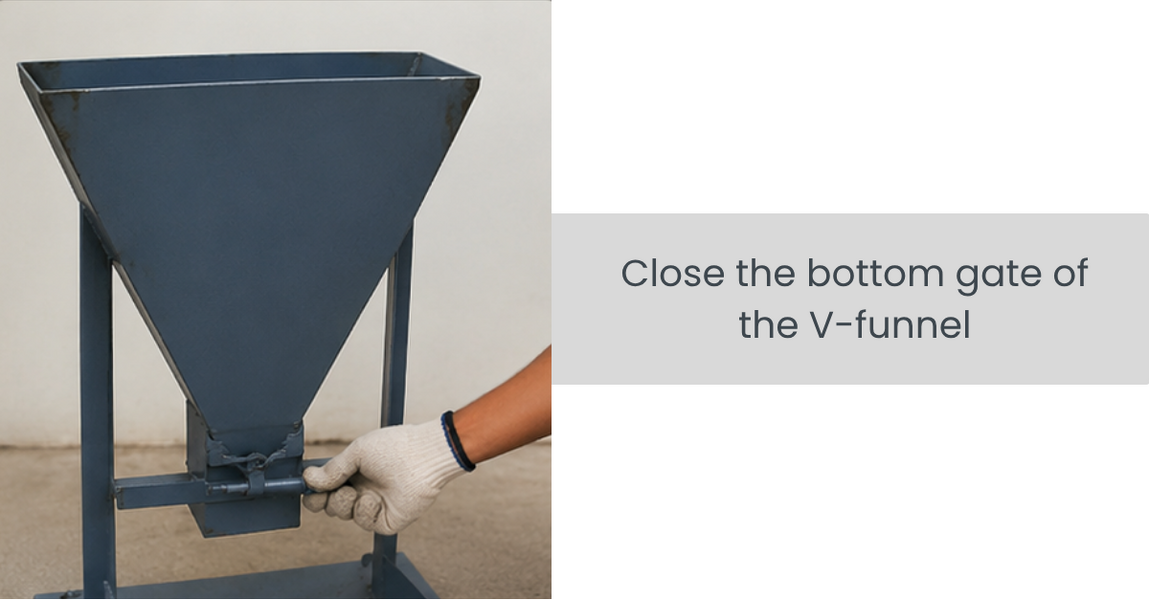
Before starting the test on V-funnel, the discharge gate located on the lower end of the V-shaped funnel needs to be closed. It will prevent the loss of the concrete during the filling process of the funnel. A properly closed gate will allow one to get accurate results from the test.
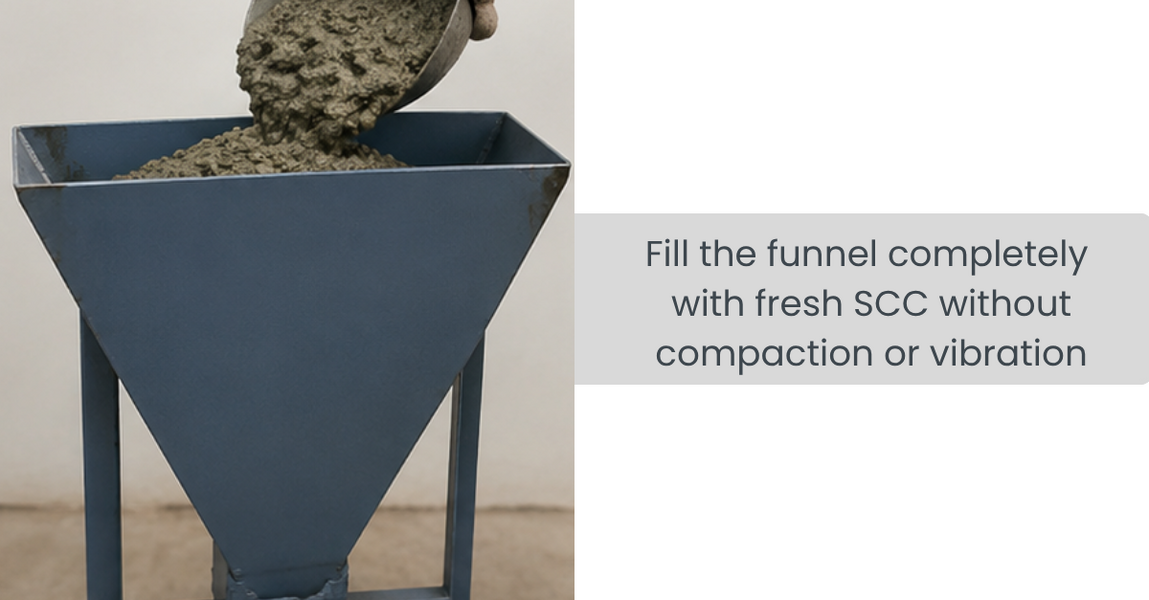
A fresh mixture of Self-compacting concrete (SCC) is placed in the V-funnel to fill it up. While filling the funnel, one cannot use any techniques such as compaction or vibration. In addition, tamping or rodding the SCC mix in the funnel should not be done because of self-leveling capabilities of the SCC mix.
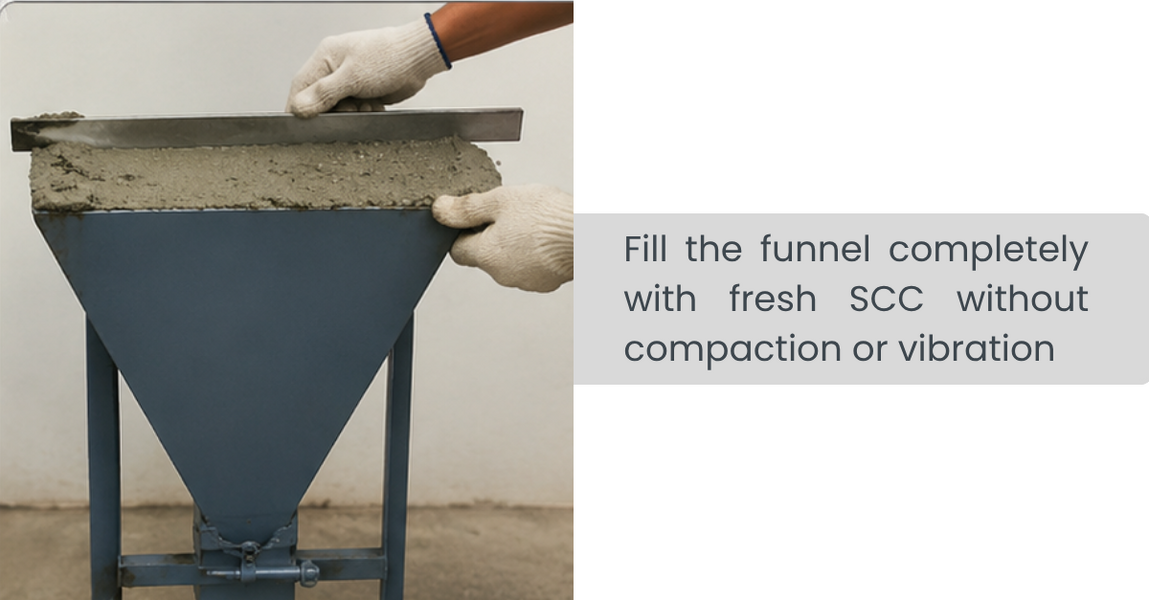
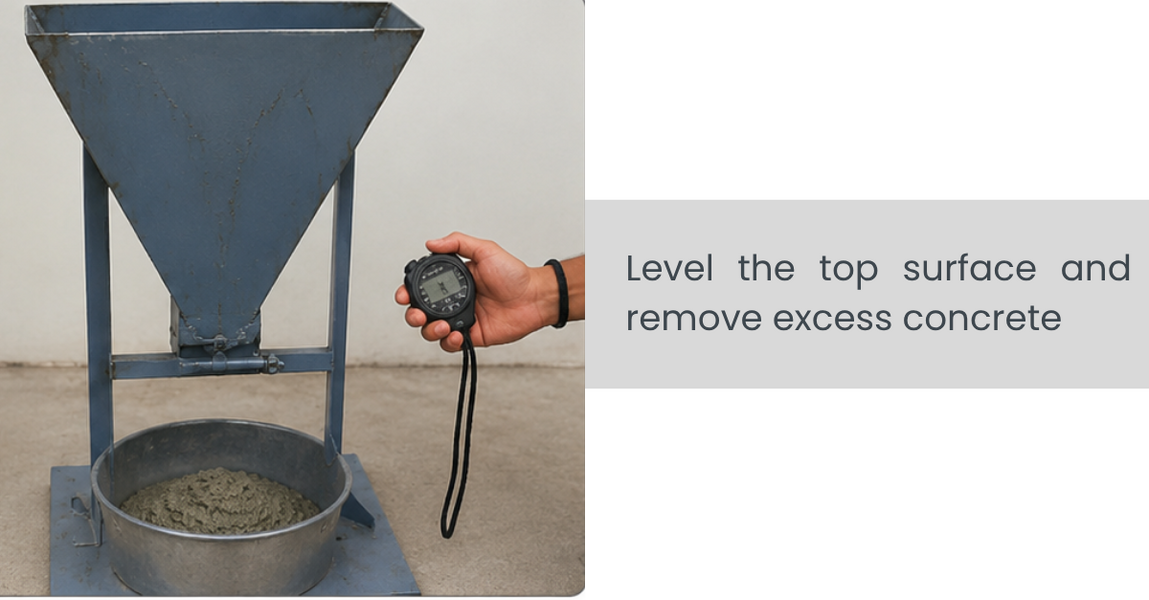
Once the funnel gets completely filled, excess concrete is removed by smoothing the top surface of the funnel. To accomplish the task of leveling, a trowel or straight edge can be used to smoothen the top surface.
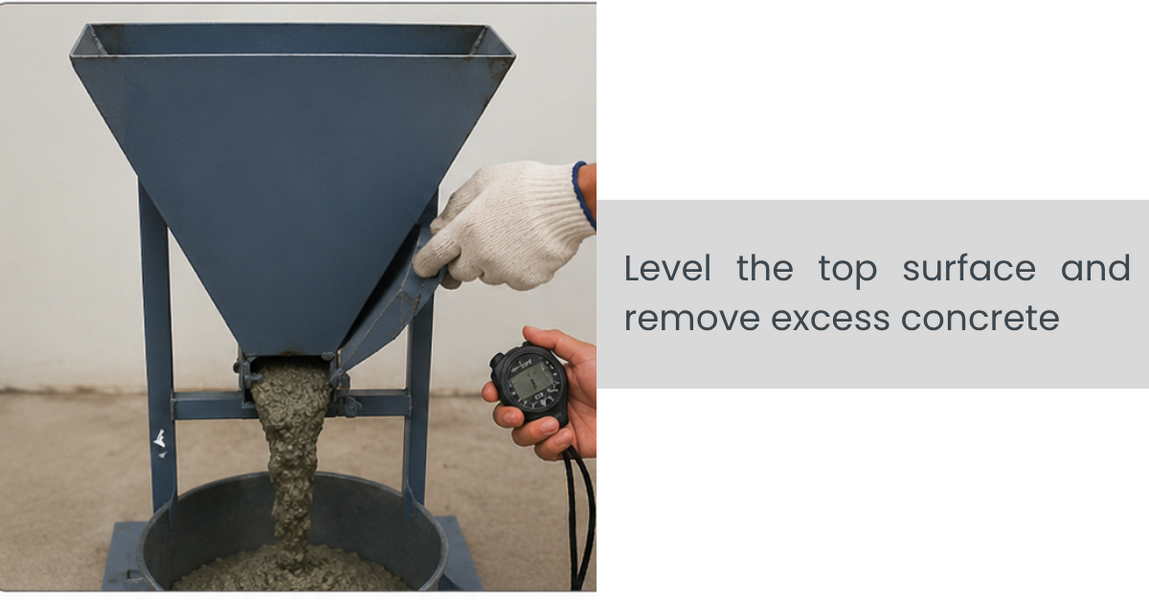
The bottom gate of the V-funnel is opened, and the stopwatch is turned on. At the moment the gate is opened, concrete starts flowing out through the funnel by the force of gravity. Precision in timing is very crucial as it will directly influence the results of the test.
The total time required for the complete discharge of concrete out of the funnel is recorded as V-funnel flow time (Tv).
Note : Typical acceptable V-Funnel Flow Time for SCC is 6–12 seconds.
A second reading after keeping concrete in the funnel for 5 minutes (T5min) is sometimes taken to evaluate segregation resistance.
This test is commonly used together with the slump flow and L-box tests for complete SCC assessment.
Objectives of V-funnel test of self-compacting concrete (SCC)
The V-funnel test is performed to determine the workability properties of freshly mixed SCC. This test will help us know whether the concrete can flow and fill formwork without any vibration.- Find out the filling properties of SCC - This test shows us whether SCC is able to flow under its own weight or not and fills formwork including congested reinforcement parts without external vibration.
- Find segregation resistance of SCC - In this test, we check whether SCC is uniformly flowable or not. If a mix of concrete is well-graded then there won't be any segregation of coarse aggregates and cementitious materials in concrete.
- Measure the viscosity of concrete mix - Viscosity means the flow properties of concrete; it determines whether the concrete is thicker or thinner than the normal mix of concrete.
Apparatus used in V-funnel test of self-compacting concrete
- V-shaped funnel made of metal
- Stopwatch
- Container for collecting concrete
Understanding V-Funnel Test Procedure step by step
Step 1: Closing of the Bottom Gate of the V-Funnel
Before starting the test on V-funnel, the discharge gate located on the lower end of the V-shaped funnel needs to be closed. It will prevent the loss of the concrete during the filling process of the funnel. A properly closed gate will allow one to get accurate results from the test.
Step 2: Filling the Funnel with Fresh SCC Without Compaction or Vibration
A fresh mixture of Self-compacting concrete (SCC) is placed in the V-funnel to fill it up. While filling the funnel, one cannot use any techniques such as compaction or vibration. In addition, tamping or rodding the SCC mix in the funnel should not be done because of self-leveling capabilities of the SCC mix.
Step 3: Smoothing the Top Surface
Once the funnel gets completely filled, excess concrete is removed by smoothing the top surface of the funnel. To accomplish the task of leveling, a trowel or straight edge can be used to smoothen the top surface.
Step 4: Open the Gate and Press the Stop Watch Together
The bottom gate of the V-funnel is opened, and the stopwatch is turned on. At the moment the gate is opened, concrete starts flowing out through the funnel by the force of gravity. Precision in timing is very crucial as it will directly influence the results of the test.
Step 5: Measure the Total Time for the Complete Flow of Concrete
The total time required for the complete discharge of concrete out of the funnel is recorded as V-funnel flow time (Tv).
Understanding the Result of V funnel flow test
Condition 1 - When V-Funnel Flow Time is Less than 6 Seconds
When the V-funnel flow time is less than 6 seconds, the SCC mix flows very quickly through the funnel. This indicates extremely high flowability and low viscosity of the concrete. Such rapid movement may occur due to excess water or a high amount of superplasticizer in the mix. Although high flowability helps placement, it can increase the risk of segregation, where coarse aggregates separate from the cement paste. Bleeding may also occur, causing poor surface quality and reduced durability. Therefore, concrete with flow time below 6 seconds is considered unstable and may require mix adjustments.Condition 2 - When V-Funnel Flow Time is Between 6–12 Seconds
When the V-funnel flow time lies between 6 and 12 seconds, the SCC is considered to have good workability characteristics. The concrete possesses a balanced combination of flowability and viscosity, allowing it to move under its own weight without segregation. The mix can fill formwork and pass through congested reinforcement areas easily without vibration. Aggregate particles remain uniformly distributed throughout the concrete, ensuring consistency and stability. This condition minimizes defects such as bleeding and honeycombing while improving surface finish, strength, and durability. Hence, this range represents the ideal behavior of SCC.Condition 3 - When V-Funnel Flow Time is Greater than 12 Seconds
When the V-funnel flow time is greater than 12 seconds, the SCC mix flows slowly because of high viscosity and low flowability. This may occur due to insufficient water, inadequate superplasticizer content, or excessive fine materials in the mix. The concrete may not spread properly and can face difficulty filling narrow sections or reinforced areas. Slow flow can trap air inside the structure, leading to voids and honeycombing. Such concrete may require external vibration, which reduces the benefits of SCC. Therefore, flow time above 12 seconds indicates poor filling ability and inadequate workability.Note : Typical acceptable V-Funnel Flow Time for SCC is 6–12 seconds.
A second reading after keeping concrete in the funnel for 5 minutes (T5min) is sometimes taken to evaluate segregation resistance.
This test is commonly used together with the slump flow and L-box tests for complete SCC assessment.

