

Building a house on a flood-prone plot is not the same as building on ordinary land. The biggest mistake people make is looking at the plot from the outside and assuming everything is fine because the ground looks hard and level.
The real condition of the site is often hidden below the surface.
During flooding, the ground can become saturated, groundwater can rise, soil can lose strength, and flowing water can wash soil away from foundations. There is also another concern that is often ignored — the quality of the water itself. Water containing high levels of chloride and other aggressive substances can affect reinforced concrete over time.
So, before construction starts, it is worth spending some time and money on proper testing.
Here are 7 important tests and investigations that should be considered for construction in a flood-prone area.
The real condition of the site is often hidden below the surface.
During flooding, the ground can become saturated, groundwater can rise, soil can lose strength, and flowing water can wash soil away from foundations. There is also another concern that is often ignored — the quality of the water itself. Water containing high levels of chloride and other aggressive substances can affect reinforced concrete over time.
So, before construction starts, it is worth spending some time and money on proper testing.
Here are 7 important tests and investigations that should be considered for construction in a flood-prone area.
1. Geotechnical Investigation for Understanding the Soil condition in flood prone area
The first thing to check is the ground itself.
A geotechnical investigation tells you what is actually underneath the plot. The soil near the surface may look perfectly good, but conditions can be very different a few metres below.
During a geotechnical investigation, engineers may drill boreholes, collect soil samples and carry out field tests to understand the different soil layers.
They are looking for answers to some basic questions:
A geotechnical investigation tells you what is actually underneath the plot. The soil near the surface may look perfectly good, but conditions can be very different a few metres below.
During a geotechnical investigation, engineers may drill boreholes, collect soil samples and carry out field tests to understand the different soil layers.
They are looking for answers to some basic questions:
- Is the soil strong enough to support the proposed building?
- Is there soft or loose soil underneath?
- How deep is the groundwater?
- Could the building experience settlement?
- How will the soil behave when it becomes wet?
- Is there a risk of erosion or scour?
This information is then used by the structural and geotechnical engineers to decide what type of foundation is suitable.
Why is this especially important in a flood-prone area?
Because soil can behave differently when it becomes saturated.
A plot that seems firm during a dry season may have very different ground conditions after prolonged rainfall or flooding.
In simple words, don’t decide your foundation by looking at the surface. Test what is underneath it.
A plot that seems firm during a dry season may have very different ground conditions after prolonged rainfall or flooding.
In simple words, don’t decide your foundation by looking at the surface. Test what is underneath it.
2. Check How the Soil Behaves Below Ground in Flood Prone Area Standard Penetration Test (SPT)
If a borehole is being drilled, one of the important tests that may be carried out is the Standard Penetration Test, commonly called the SPT test.
The test gives engineers an indication of how resistant the soil is to penetration. The results help them understand whether the soil is relatively loose, dense, soft or firm at different depths.
This is useful because the soil may not have the same properties throughout the entire site.
For example, you could have:
The test gives engineers an indication of how resistant the soil is to penetration. The results help them understand whether the soil is relatively loose, dense, soft or firm at different depths.
This is useful because the soil may not have the same properties throughout the entire site.
For example, you could have:
- Top layer → relatively firm soil
- Below it → loose soil
- Further down → stronger soil
Without investigating the ground, you simply wouldn’t know this.
Why does Standard Penetration Test SPT matter for a flood-prone site?
Flooding and high groundwater can affect soil conditions, particularly where loose or weak soils are present. SPT results are therefore one part of the information engineers use when deciding how a foundation should be designed.
But don’t make the mistake of treating the SPT number as the final answer.
SPT is one piece of the puzzle. It needs to be considered along with soil samples, groundwater information, laboratory tests and the proposed building load.
But don’t make the mistake of treating the SPT number as the final answer.
SPT is one piece of the puzzle. It needs to be considered along with soil samples, groundwater information, laboratory tests and the proposed building load.
3. Groundwater and Soil Testing to Find Out What Happens When the Ground Gets Wet
Floodwater is visible, but groundwater is not.
And for construction, what happens below the ground can be just as important.
A site investigation should identify the groundwater level and, where necessary, consider how it changes during wet periods.
Engineers may also recommend laboratory tests to understand the soil’s properties, including its strength, grain size, plasticity, moisture characteristics and other relevant parameters.
One useful test in certain situations is the permeability test.
And for construction, what happens below the ground can be just as important.
A site investigation should identify the groundwater level and, where necessary, consider how it changes during wet periods.
Engineers may also recommend laboratory tests to understand the soil’s properties, including its strength, grain size, plasticity, moisture characteristics and other relevant parameters.
One useful test in certain situations is the permeability test.
What does a permeability test tell you?
It tells engineers how easily water can move through the soil.
For example, water can move quite differently through sandy soil compared with dense clay.
This matters when planning:
For example, water can move quite differently through sandy soil compared with dense clay.
This matters when planning:
- Foundation excavation
- Drainage
- Dewatering
- Waterproofing
- Ground improvement
- Site drainage systems
A flood-prone plot is essentially a site where soil and water have to be considered together.
You aren’t just asking, “How strong is this soil?”, You are also asking: “What happens to this soil when there is a lot of water?”
You aren’t just asking, “How strong is this soil?”, You are also asking: “What happens to this soil when there is a lot of water?”
4. Importance of Water Chloride Test Don’t Ignore the Water Around Your Foundation
This is one test that many people don’t think about until there is already a problem.
If groundwater, floodwater or another water source is likely to come into contact with the building, it can be useful to test its chemical characteristics.
One important parameter is chloride.
A chloride test measures the amount of chloride present in the water.
If groundwater, floodwater or another water source is likely to come into contact with the building, it can be useful to test its chemical characteristics.
One important parameter is chloride.
A chloride test measures the amount of chloride present in the water.
Why should a construction company care about chloride?
Because reinforced concrete contains steel reinforcement. If chloride ions penetrate the concrete and reach the reinforcement under suitable conditions, they can contribute to corrosion of the steel.
And corrosion is not something you want to discover several years after completing the building.
As reinforcement corrodes, the steel can expand. That can lead to cracking and eventually spalling, where pieces of concrete begin breaking away and the reinforcement becomes exposed.
And corrosion is not something you want to discover several years after completing the building.
As reinforcement corrodes, the steel can expand. That can lead to cracking and eventually spalling, where pieces of concrete begin breaking away and the reinforcement becomes exposed.
Where can chloride come from in the water ?
Depending on the location, it may be present in:
- Saline groundwater
- Coastal environments
- Floodwater
- Certain industrial sources
- Contaminated water
- Saline soil conditions
This doesn’t mean every flood-prone plot has a chloride problem. It means that where chloride exposure is possible, it is better to test the water than to assume it is harmless. And chloride isn’t the only parameter that may matter. Depending on the site, engineers may recommend testing other chemical characteristics of the groundwater or soil as well.
5. Soil Bearing Capacity and Settlement Tests to ensure Foundation Stay Stable?
The foundation transfers the weight of the building into the soil. If the soil cannot safely support the load, the foundation design needs to change.
Engineers use information from the geotechnical investigation, field tests and laboratory results to assess bearing capacity and expected settlement.
In some sites, a consolidation test may also be required, particularly where soft or compressible soil is present.
This test helps engineers understand how soil may compress under load over time.
Engineers use information from the geotechnical investigation, field tests and laboratory results to assess bearing capacity and expected settlement.
In some sites, a consolidation test may also be required, particularly where soft or compressible soil is present.
This test helps engineers understand how soil may compress under load over time.
Why is soil settlement a concern while we are starting construction ?
You may not see a building suddenly collapse.
Instead, problems can develop slowly:
Instead, problems can develop slowly:
- Cracks appear in walls.
- Floors become uneven.
- Doors don’t close properly.
- Parts of the building settle differently.
- Cracks develop around structural elements.
In a flood-prone location, the condition of the soil when saturated needs to be considered as part of the overall foundation assessment.
The objective is not simply to find a foundation that works today.
It is to design one that remains suitable as the ground and environmental conditions change.
The objective is not simply to find a foundation that works today.
It is to design one that remains suitable as the ground and environmental conditions change.
6. Concrete Slump and Cube Test to Check the Concrete Before Trusting It
Once the foundation and structural design are ready, attention turns to the concrete.
Two familiar quality-control tests are the slump test and the concrete cube test.
Two familiar quality-control tests are the slump test and the concrete cube test.
Slump test on fresh concrete
The slump test is carried out on fresh concrete. It gives an indication of the concrete’s consistency and workability. If concrete is too stiff, it can be difficult to place and compact properly. But there is another common problem on construction sites: adding extra water simply to make the concrete easier to work with.
That may make the concrete flow more easily, but uncontrolled additional water can affect the mix’s water-cement ratio and ultimately its strength and durability.
So the slump should be checked against the requirements of the approved mix and project specifications — not adjusted casually by adding water.
That may make the concrete flow more easily, but uncontrolled additional water can affect the mix’s water-cement ratio and ultimately its strength and durability.
So the slump should be checked against the requirements of the approved mix and project specifications — not adjusted casually by adding water.
Cube test to check compressive strength of concrete
The cube test checks the compressive strength of hardened concrete. Concrete samples are taken from the construction work, cubes are prepared and cured, and then they are tested at the specified age. The result gives the project team actual evidence of how strong the concrete is.
That’s much better than simply looking at the concrete and saying: “It looks good.”
That’s much better than simply looking at the concrete and saying: “It looks good.”
7. Concrete Durability, Cover and Curing Tests
This final point is particularly important for a flood-prone area. People often focus entirely on the concrete grade and cube-test result.
But a building can have concrete that meets its compressive-strength requirement and still have durability problems if the concrete is poorly made or poorly placed.
Three things deserve particular attention :
But a building can have concrete that meets its compressive-strength requirement and still have durability problems if the concrete is poorly made or poorly placed.
Three things deserve particular attention :
Proper water-cement ratio
Too much water in the concrete can increase its porosity and make it easier for water and aggressive substances to penetrate.
Adequate concrete cover
The reinforcement needs sufficient concrete cover to provide the protection required by the design and exposure conditions.
Think of the cover as a protective layer around the steel.
Think of the cover as a protective layer around the steel.
Proper curing
Concrete needs proper curing after placement. Poor curing can affect strength development and increase the risk of cracking and permeability.
This becomes particularly important when a building is exposed to repeated wetting, groundwater, flooding or potentially aggressive water.
This becomes particularly important when a building is exposed to repeated wetting, groundwater, flooding or potentially aggressive water.
A Simple 7-Point Checklist Before starting construction in flood prone area
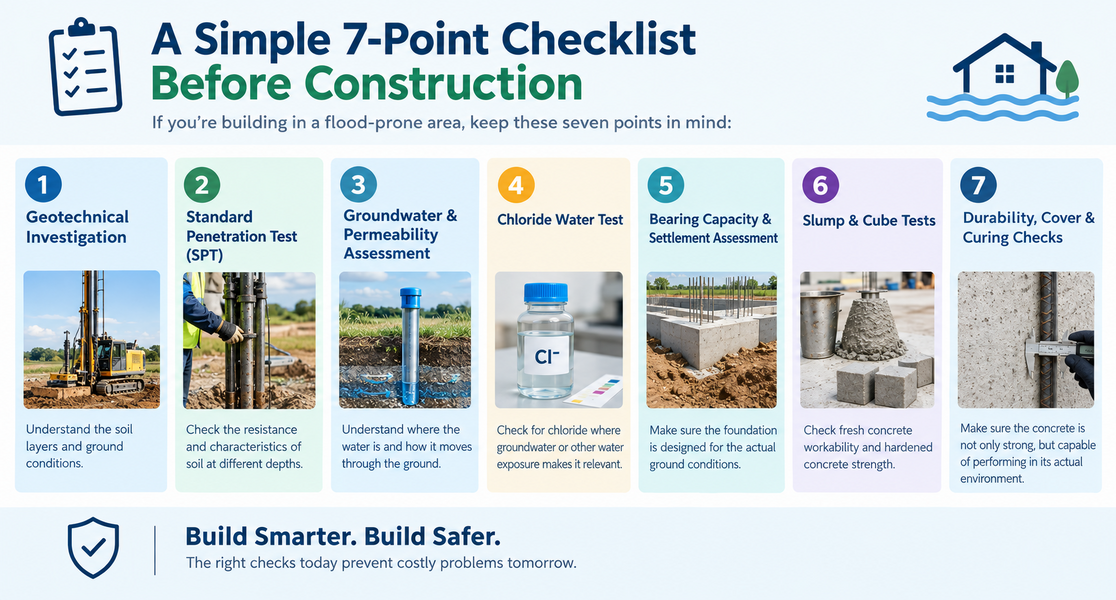
If you’re building in a flood-prone area, keep these seven points in mind:
 Geotechnical Investigation - Understand the soil layers and ground conditions.
Standard Penetration Test (SPT) - Check the resistance and characteristics of soil at different depths.
Groundwater & Permeability Assessment - Understand where the water is and how it moves through the ground.
Chloride Water Test - Check for chloride where groundwater or other water exposure makes it relevant.
Bearing Capacity & Settlement Assessment - Make sure the foundation is designed for the actual ground conditions.
Slump & Cube Tests - Check fresh concrete workability and hardened concrete strength.
Durability, Cover & Curing Checks - Make sure the concrete is not only strong, but capable of performing in its actual environment.
If your plot is in a flood-prone area, don’t wait until the foundation is being excavated to start asking questions.
Test the soil before designing the foundation. Test the water where exposure is a concern. Test the concrete while construction is happening.
These tests may feel like an additional expense at the beginning of a project.
But compared with repairing a foundation, dealing with settlement, replacing damaged concrete or addressing reinforcement corrosion later, testing is a relatively small investment in protecting a much larger one.
Most importantly, don’t rely on a neighbour’s experience or on how the plot looks during the dry season. Every site has its own ground conditions.
Geotechnical Investigation - Understand the soil layers and ground conditions. Standard Penetration Test (SPT) - Check the resistance and characteristics of soil at different depths. Groundwater & Permeability Assessment - Understand where the water is and how it moves through the ground.Chloride Water Test - Check for chloride where groundwater or other water exposure makes it relevant.Bearing Capacity & Settlement Assessment - Make sure the foundation is designed for the actual ground conditions.Slump & Cube Tests - Check fresh concrete workability and hardened concrete strength.Durability, Cover & Curing Checks - Make sure the concrete is not only strong, but capable of performing in its actual environment.If your plot is in a flood-prone area, don’t wait until the foundation is being excavated to start asking questions.
Test the soil before designing the foundation. Test the water where exposure is a concern. Test the concrete while construction is happening.
These tests may feel like an additional expense at the beginning of a project.
But compared with repairing a foundation, dealing with settlement, replacing damaged concrete or addressing reinforcement corrosion later, testing is a relatively small investment in protecting a much larger one.
Most importantly, don’t rely on a neighbour’s experience or on how the plot looks during the dry season. Every site has its own ground conditions.

